
Buscando a Alpha Review 2024:Vale a pena o investimento para os investidores?
Divulgação: Esta postagem pode receber remuneração de parceiros listados por meio de parcerias afiliadas, sem nenhum custo para você. Isso não influencia nossas classificações e as opiniões são nossas. Saiba mais aqui.
Se você deseja uma análise aprofundada e detalhada do Seeking Alpha, você veio ao lugar certo.
Primeiro, você descobrirá o que é o Seeking Alpha, como o Seeking Alpha pode beneficiar você e seus investimentos, e depois entraremos em mais detalhes, como:
- Os prós e os contras da Busca Alfa
- Como usar algumas das ferramentas do Seeking Alpha
- Como o Seeking Alpha pode ajudá-lo a aumentar sua riqueza
Você pode se tornar um membro básico do Seeking Alpha gratuitamente, assinar o Plano Premium do Seeking Alpha (que é o que eu uso) ou pode usar o Plano Pro.
Pronto para ver se o Seeking Alpha é a melhor plataforma de pesquisa de investimentos para você?
Vamos mergulhar de cabeça.
Avaliação geral:
Avaliado com 4,8 de 5
Ferramentas personalizadas
Conteúdo de alta qualidade
Análise aprofundada de ações
Pode ser viciante
Interface complexa
Pode ser opressor
Seeking Alpha é uma plataforma de pesquisa de investimentos projetada para investidores intermediários a avançados que desejam informações econômicas, imparciais e quantitativas.
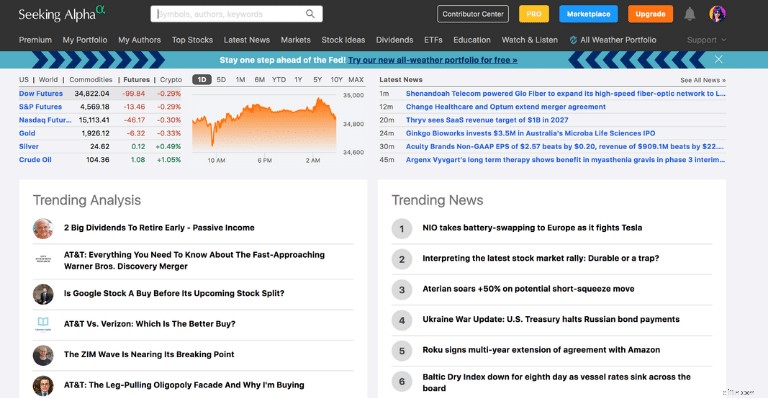
Algumas ferramentas que você pode começar a utilizar se inscrever-se no Seeking Alpha , incluem:
- Rastreador de portfólio virtual personalizado
- Vincule e analise seu portfólio real
- Acesso exclusivo à análise de tendências de ações
- Rastreador de desempenho de ações individual personalizado
Desde o início do Seeking Alpha em 2004, a plataforma atraiu mais de 20 milhões de usuários mensais.
O que significa ‘Buscar Alfa’?
Aqui está algo interessante que você talvez não soubesse sobre o nome Seeking Alpha:
O termo “alfa” não é apenas a primeira letra do alfabeto grego, mas também foi usado pelos gregos para representar o número 1.
O termo “alfa” é na verdade também um termo financeiro e é expresso como o seguinte símbolo:
Aqui está o que o termo “alfa” significa em termos financeiros:
O alfa de um portfólio é normalmente expresso como um número positivo, um número negativo ou 0.
Aqui está o que esses números significariam:
2%
Portfólio superou o mercado em 2%
0%
Portfólio com desempenho alinhado ao mercado
-2%
O portfólio teve desempenho inferior ao do mercado em 2%
Então, na realidade, a plataforma Seeking Alpha tem um jogo de palavras muito inteligente com seu título.
Seeking Alpha representa nosso desejo de construir um portfólio que possa superar o mercado.
Como funciona o Buscando Alpha?
O objetivo final do Seeking Alpha é ajudar investidores fundamentais a compartilhar informações e ideias com investidores que pensam da mesma forma na plataforma.
Depois de se inscrever e se tornar um membro do Seeking Alpha, você terá acesso exclusivo a artigos e boletins informativos de autoria de investidores fundamentais experientes e credenciados.

A maior credencial relacionada a investimentos que alguém pode obter (além talvez de um doutorado) é a certificação CFA.
Embora nem todos os autores possam ter uma designação CFA – o que é perfeitamente aceitável – aqueles que possuem as letras CFA também são ótimos candidatos para aprender.
Mesmo se você estiver no plano gratuito do Seeking Alpha, você ainda pode ter acesso a:
- Comentários completos sobre suas ações favoritas
- Acesso às ferramentas proprietárias de classificação de ações da Seeking Alpha
- Análise de estoque publicada e aprofundada (até 5 artigos gratuitos por mês)
Dê uma olhada apenas em um trecho dos muitos artigos que são publicados diariamente:
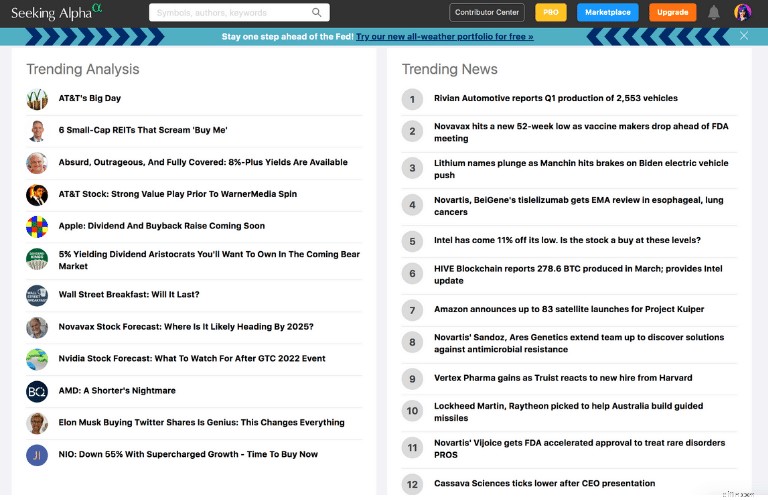
Na verdade, Seeking Alpha possui mais de 7.000 autores ativos e experientes que publicam mais de 10.000 análises aprofundadas todos os meses.
Esses autores se aprofundam nas ações , revisando as finanças de cada empresa e dando sua própria opinião, se aquela ação deveria ser:
- Comprar
- Vender
- Espere
- Venda forte
- Compra forte
Agora, além de aprender com seus colegas profissionais de investimento sobre cada ação, o Seeking Alpha também oferece a oportunidade de fazer sua própria pesquisa.
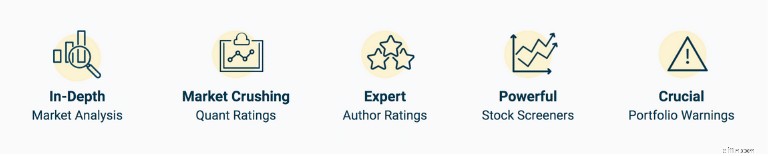
Algumas ferramentas de pesquisa interessantes que podem ser acessadas por qualquer membro Premium e Pro incluem:
- Rastreador de ETF personalizado
- Análise de portfólio personalizada
- Rastreador de desempenho de ações personalizado
Entraremos em mais detalhes sobre essas ferramentas posteriormente neste artigo (continue lendo!).
A ideia principal aqui é que o Seeking Alpha oferece o melhor dos dois mundos:você pode aprender e interagir com seus colegas, bem como receber experiência prática quando se trata de pesquisa de investimentos.
Buscando prós e contras do Alpha
Vamos dar uma olhada geral nos prós e contras do Seeking Alpha (para as opções pagas):
Mínimo ou nenhum anúncio
Caro se você for um investidor casual
Acesso a boletins informativos diários exclusivos, entrevistas e artigos
Menos cobertura em criptografia em comparação com outros setores
Análise quantitativa criteriosa de ações
Está focado em pesquisas de investimentos e não automatiza seus próprios investimentos
Personalize alertas de estoque (você receberá notificações push)
Usabilidade/interface pode ser confusa
Artigos crowdsourced oferecem a oportunidade de interagir diretamente com os autores
A maioria dos artigos e ações concentra-se principalmente nos EUA (e às vezes no Canadá)
Você pode personalizar muitas das ferramentas do Seeking Alpha
Pode ser complexo se você for um investidor passivo (sem day trading)
Buscando a classificação geral Alfa
Antes de continuar lendo, verifique minhas classificações para cada uma das 6 categorias a seguir:
Informações sobre investimentos
⭐️⭐️⭐️⭐️⭐️
Ferramentas de investimento
⭐️⭐️⭐️⭐️⭐️
Atendimento ao Cliente
⭐️⭐️⭐️⭐️⭐️
Usabilidade
⭐️⭐️⭐️⭐️⭐️
Custo
⭐️⭐️⭐️⭐️
Para dar um pouco mais de detalhes sobre o motivo de minhas avaliações, dê uma olhada no meu detalhamento abaixo:
- Informações sobre investimentos - Os leitores recebem muitas informações, desde boletins informativos diários até classificações quantitativas, de Wall Street Analyst e de Seeking Alpha de ações de autores
- Ferramentas de investimento – Como membro Premium ou Pro, você recebe acesso a diversas ferramentas diferentes do Seeking Alpha. No entanto, eles podem ser um pouco difíceis de entender se você for um investidor casual
- Atendimento ao cliente – Falei pessoalmente com três representantes diferentes de atendimento ao cliente da Seeking Alpha, todos extremamente amigáveis, receptivos e corretos com suas informações. Pela minha experiência, a equipe de atendimento ao cliente da Seeking Alpha é muito profissional
- Usabilidade – Para alguém que é um investidor iniciante, as diferentes ferramentas do Seeking Alpha podem parecer um pouco complicadas. No entanto, se você é um investidor intermediário a experiente e sabe o que está fazendo, o Seeking Alpha é muito fácil de usar.
- Custo – Você não ganha muito com a versão de acesso limitado (também conhecida como gratuita), mas ganha muito pelo seu dinheiro se se inscrever na versão Premium (US$ 19,99 por mês). A versão Pro, na minha opinião, só faz sentido se você for um profissional ou levar muito a sério investimentos ativos (US$ 199,99 por mês)
Até agora, estou bastante impressionado com Seeking Alpha.
Sobre a busca pelo Alfa
Buscando Alpha foi fundada em 2004 por David Jackson.
David trabalhou como analista de pesquisa de ações e tecnologia no Morgan Stanley durante a bolha tecnológica, pesquisando ações e escrevendo suas descobertas.
Foi durante este período que David percebeu que havia um conflito de interesses inerente se os grandes bancos de investimento publicassem as suas pesquisas sobre determinados produtos de investimento, especialmente se os grandes bancos vendessem esses produtos de investimento.
Por que um grande banco de investimento publicaria um artigo de pesquisa sobre um produto abaixo da média que o próprio banco vende?
Foi assim que nasceu o Buscando Alfa.
Aqui estão mais alguns detalhes que você deve saber sobre o Seeking Alpha:
Ano de fundação
2004
Localização da Sede
Ra'anana, Israel
Usuários mensais
20 milhões +
Visualizadores mensais
40 milhões +
Autores ativos mensais
Mais de 7.000
Artigos publicados mensalmente
10.000+
Custo Mensal
– Acesso limitado =$0
– Prêmio =$ 19,99
– Pró =$ 199,99
Quem deve usar o Buscando Alpha
– Investidores intermediários
– Investidores avançados
– comerciantes diurnos
Tipo de conteúdo
– Podcasts
– Conteúdo de vídeo
– Conteúdo escrito
Recursos de destaque
– Demonstrações financeiras
– Transcrições de chamadas de ganhos
– Notificações de estoque personalizadas
– Análise aprofundada de especialistas
– Sistema transparente de classificação de ações
– Gráficos de comparação de desempenho de ações
Disponibilidade
-iPad
– Área de trabalho
-Android
– iPod touch
– iPhone (iOS 12.2 ou posterior)
Atendimento ao Cliente
– Telefone
– Fórum
Horário de Atendimento ao Cliente
De segunda a sexta, das 8h às 16h EST
Disponibilidade do país
Internacional
Embora o Seeking Alpha esteja disponível para um público internacional, devo observar que o principal foco de pesquisa de investimento da plataforma está nos Estados Unidos e no Canadá.
Buscando Usabilidade e Interface Alfa
Sou um grande fã da interface do site Seeking Alpha.
Pessoalmente, acho que o Seeking Alpha é muito fácil de usar, intuitivo e também faz um bom trabalho ao exibir as informações de forma organizada.
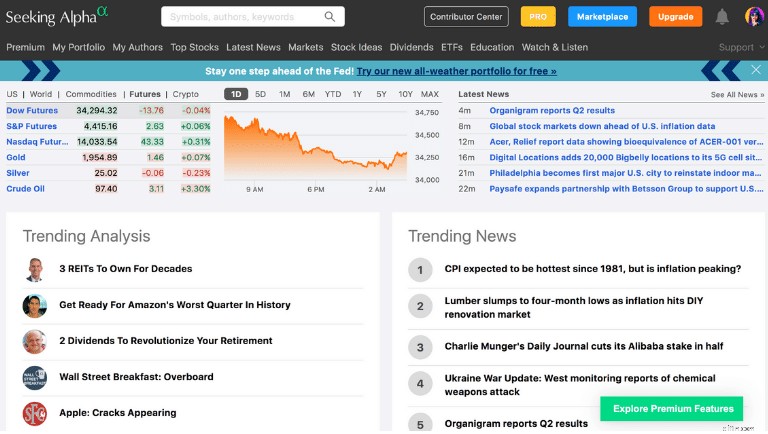
Agora, o único feedback construtivo que eu gostaria de receber é que para investidores iniciantes – e até mesmo para usuários intermediários – as informações sobre o Seeking Alpha nem sempre podem ser encontradas intuitivamente.
Por exemplo, se você estiver procurando os principais ETFs de mercados emergentes, provavelmente não saberá onde procurar.
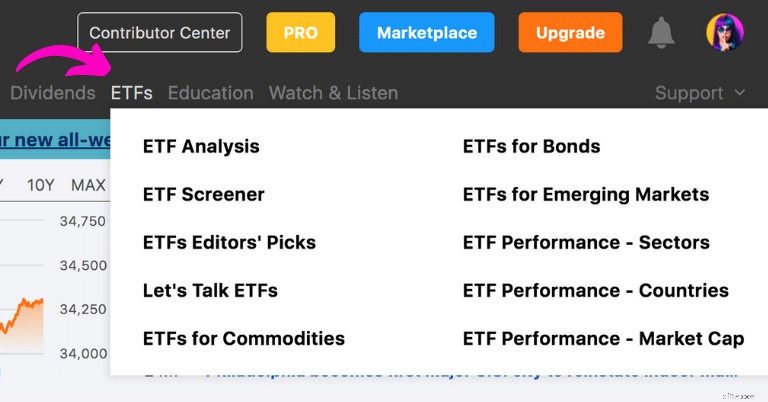
O único lugar lógico onde eu procuraria ETFs de mercados emergentes seria na aba ETF – mas ainda não há mais informações sobre ETFs de mercados emergentes.
Na realidade, para encontrar os principais ETFs de mercados emergentes, você teria que clicar em “ETF Screener” e “ETF Performance – Sector”.
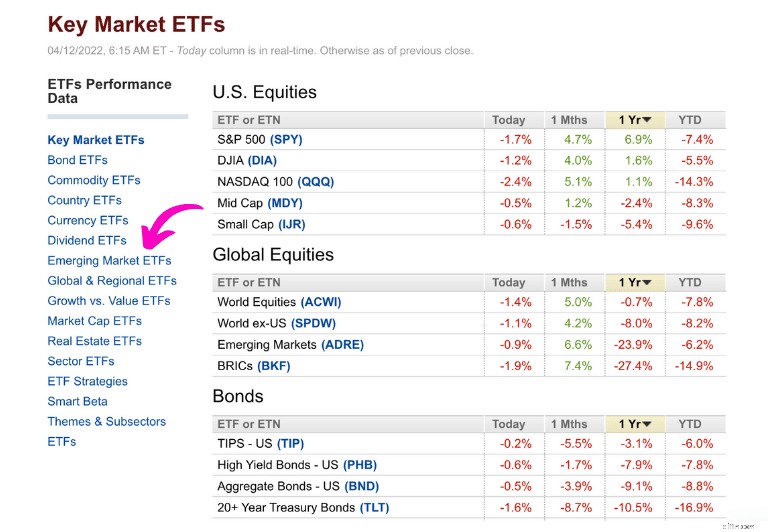
A partir daí, você terá que clicar na barra de ferramentas à esquerda para classificar a categoria de ETF (neste caso, mercados emergentes) que você está procurando.
No geral, Seeking Alpha construiu uma fantástica plataforma de pesquisa fundamental para cada investidor.
Você provavelmente terá apenas uma pequena curva de aprendizado antes de se familiarizar totalmente com a plataforma e como ela funciona.
Buscando planos e preços alfa
O Seeking Alpha possui 3 planos, sendo 2 versões pagas:
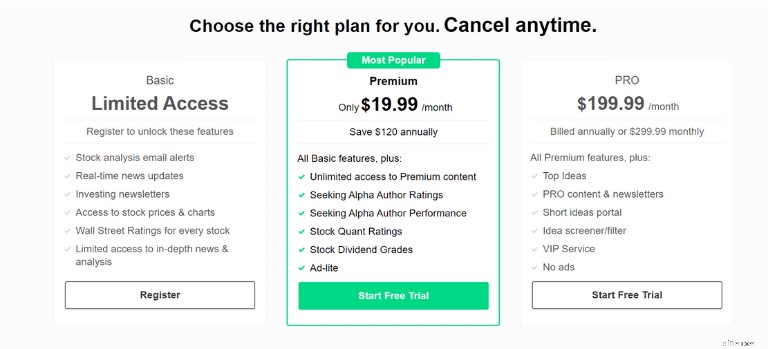
Eu uso o Plano Premium e estou muito feliz com sua funcionalidade e recursos.
Aqui está o que você pode esperar ao abrir uma conta no Seeking Alpha:
Custo Mínimo
$0 [Plano de acesso limitado]
Custo Máximo
$ 199,99/mês [Plano Pro]
Métodos de pagamento
–Paypal
– Cartão de crédito
Lembre-se de que seus planos Premium (ou Pro) serão cobrados anualmente para capturar os custos mensais de US$ 19,99 (Premium) ou US$ 199,99 (Pro).
Caso contrário, você pagaria US$ 29,99/mês (Premium) e US$ 299,99/mês (Pro).
Aqui está uma breve visão geral do que você obtém com cada assinatura do Seeking Alpha:
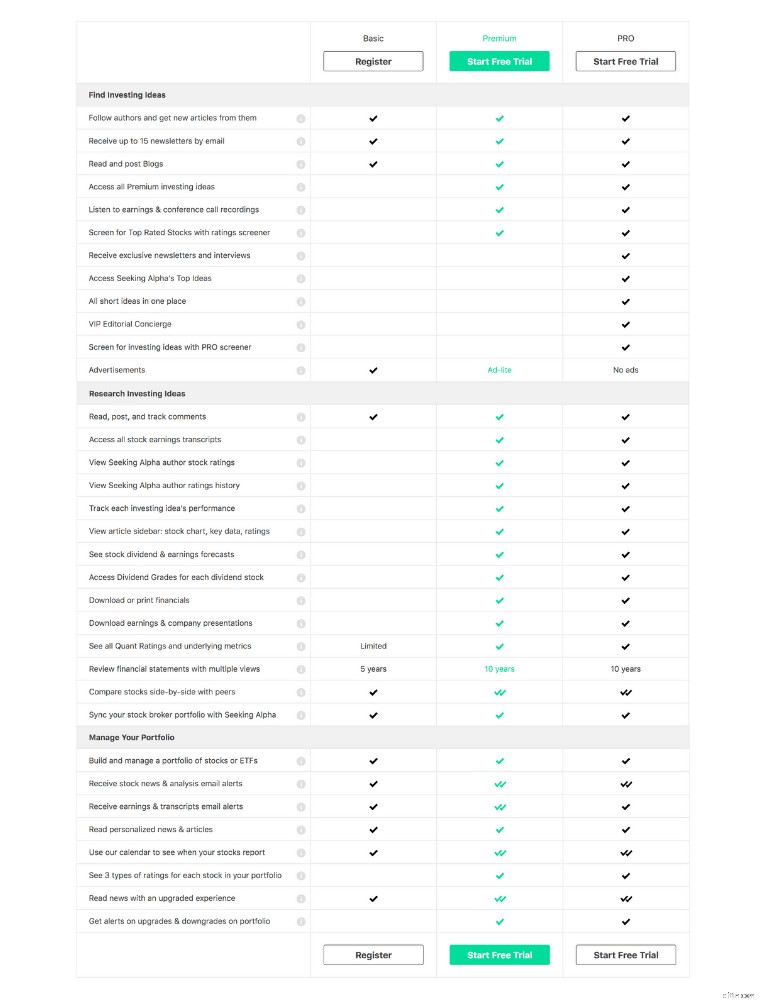
A boa notícia é que você pode iniciar um teste gratuito de 14 dias com o Plano Premium e até mesmo com os Planos Pro.
Normalmente falando, você deve receber um e-mail de lembrete alguns dias antes do término do período de teste, mas li várias reclamações de que os cartões de crédito foram cobrados assim que o período de teste terminou.
Continue lendo o trecho a seguir, pois explicarei com mais detalhes sobre cada serviço e o que você ganha com seu dinheiro.
Quem deve assinar os planos pagos do Seeking Alpha?
Se um plano Seeking Alpha vale o custo, realmente depende de você e de seus objetivos.
Abaixo, dividi um gráfico simples para mostrar qual plano provavelmente seria melhor se você:
Leia artigos diariamente
✔️
✔️
Interaja com autores
✔️
✔️
Alertas por e-mail
✔️
✔️
Sem anúncios
✔️
Aproveite a análise
✔️
✔️
Quer atendimento VIP
✔️
Quer conteúdo exclusivo
✔️
É um day trader
✔️
✔️
Dinheiro não é uma preocupação
✔️
Pessoalmente, acho que o plano Premium é perfeito para quem é uma pessoa normal e deseja:
- Interaja com pessoas que pensam como você
- Saiba mais sobre o lado técnico do investimento
- Tome decisões informadas sobre o mercado de ações
A menos que você seja realmente um day trader ou administre seu próprio pequeno negócio e precise de um toque exclusivo adicional, eu diria que o Plano Premium é provavelmente o melhor valor, dado o que você está gastando.
Buscando o desempenho da seleção de ações da Alpha
Embora vencer o mercado de forma consistente seja quase impossível, o Seeking Alpha certamente oferece a vantagem de superar o mercado.
Na verdade, desde 2010, o algoritmo quantitativo do Seeking Alpha superou substancialmente o desempenho do S&P 500, superando-o 9 em cada 10 vezes.
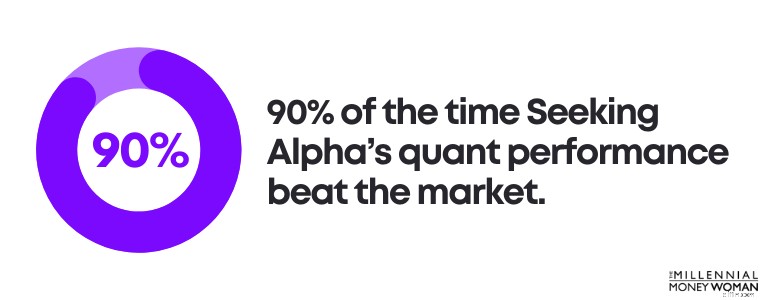
As ações “muito otimistas” retornaram 1.754%, enquanto o S&P 500 retornou apenas 385%.
Então, como você obtém acesso a uma ferramenta que aumenta drasticamente suas chances de superar o mercado?
Ao se inscrever no Pacote Procurando Alpha Premium .
Pense desta forma:
- Você começa a investir US$ 10.000 em 2010 e não faz contribuições de investimento adicionais
- Você teria US$ 139.344 a mais se tivesse usado as recomendações de ações “muito otimistas” do Seeking Alpha em vez de investir no S&P 500
Basta ter em mente que o desempenho passado não indica necessariamente o desempenho futuro.
Buscando Plano de Acesso Limitado Alpha
Se você não está pronto para gastar dinheiro no Seeking Alpha e deseja apenas se inscrever no plano gratuito, confira esta seção, dedicada ao Plano de Acesso Limitado:
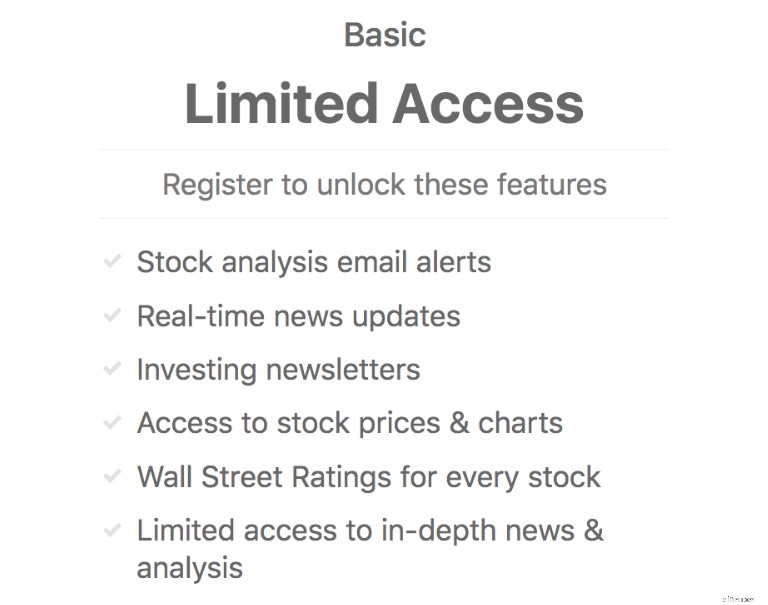
Com o plano de acesso limitado, algumas coisas que você pode fazer incluem:
- Receba até 15 boletins informativos por e-mail
- Acessar transcrições e relatórios de ganhos
- Siga e interaja com os autores do Seeking Alpha
- Acesse até cinco artigos do Buscando Alfa por mês
- Conecte seu portfólio pessoal com o Seeking Alpha (para análise de suas ações)
Algumas desvantagens do plano de acesso limitado incluem:
- Você será exposto a vários anúncios
- Você não tem acesso a análises de especialistas
- Não é possível acessar todas as métricas de ações subjacentes
- Você só tem acesso às classificações de Wall Street
- Não é possível acessar todas as classificações quantitativas de ações
- Você só pode revisar demonstrações financeiras de até 5 anos (e não 10)
Se você estiver interessado e quiser mais, considere assinar um dos planos pagos do Seeking Alpha (o Premium ou o Pro).
Procurando Plano Alpha Premium
O interessante do plano Seeking Alpha Premium (e Pro) é que você pode iniciar um período de avaliação gratuita de 14 dias para testar o plano antes de se comprometer financeiramente.
Você pode cancelar seu período de avaliação a qualquer momento para garantir que o valor total não seja cobrado (o que o Seeking Alpha pode fazer se você não cancelar antes do término da avaliação).
Se você gostou do período de teste do Plano Premium, poderá pagar pelo Plano Premium de 3 maneiras:
Plano Mensal
US$ 29,99/mês
Plano Anual
$ 239 (ou $ 19,99/mês, conforme anunciado)
Plano de 3 anos
$ 540 (ou $ 14,99/mês)
Parece que o caso padrão para o Seeking Alpha é cobrar antecipadamente o valor dos prêmios do ano inteiro (ou seja, US$ 239 para o Plano Premium).
Um dos maiores benefícios de se inscrever no Plano Premium em relação ao plano de Acesso Limitado é que você ganha acesso exclusivo à comunidade de investidores, para que possa:
- Interagir com autores
- Compare seu portfólio com os portfólios dos autores
- Acesse análises quantitativas e fundamentais de ações aprofundadas
- Acesse teleconferências, teleconferências de resultados, apresentações etc.
Sou usuário do Plano Premium e o que mais gosto é que você pode literalmente debater ideias com seus colegas sobre seu próximo investimento.
Em busca de recursos Alpha Premium
Nesta seção, explicarei em detalhes alguns dos meus recursos favoritos do Plano Premium e como você pode se beneficiar de cada um.
Esta é uma visão geral dos recursos do Seeking Alpha Premium:
- Ad Lite
- Metas de preço
- Chamadas notáveis
- Conferências de resultados
- Classificações do autor
- Notas de dividendos
- Painel de notícias
- Cartão de pontuação do fator
- Comparações entre pares
- Personalização de alertas
- Classificações quantitativas
- Ferramentas de triagem de estoque
- Consenso de Wall Street
- Gráficos de visualização de dados
- Acesso ilimitado aos artigos
- Crie seu próprio portfólio simulado
- Gerencie seus alertas de preços personalizados
- Demonstrações financeiras para download
- Ferramenta de comparação de desempenho de ações
- Vincule sua conta de investimento externo
Se você quiser saber mais sobre esses recursos, continue lendo.
Recurso nº 1 do plano Premium:Ad-Lite
Ao contrário do plano de Acesso Limitado, que pode ter muitos anúncios, o Plano Premium oferece uma experiência de usuário “ad-lite”.
Por exemplo, você pode receber alguns banners durante sua navegação, como os seguintes:
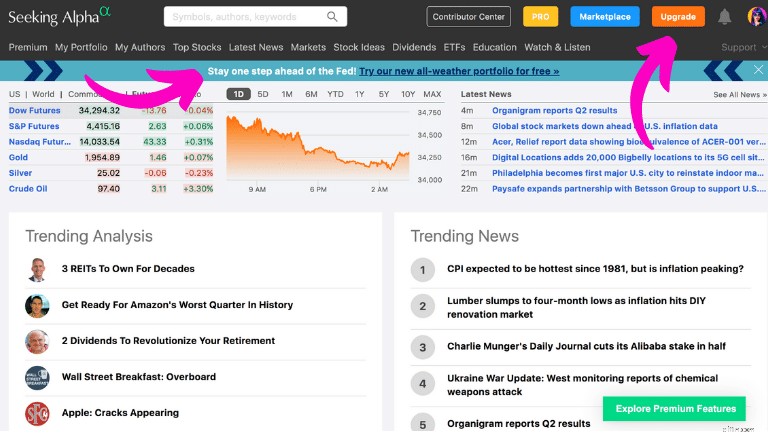
Como você pode ver na minha assinatura Premium, o Seeking Alpha promove alguns de seus produtos (neste caso, o pacote Pro).
Para ser honesto, não estou realmente incomodado com esses anúncios e não acho que eles prejudiquem minha experiência.
Recurso nº 2 do plano Premium:metas de preços
Você está se perguntando se uma ação está sobrevalorizada ou subvalorizada?
Verifique as classificações de Wall Street para essa ação e vá até a seção “Preço-alvo”.
Nesse caso, usei o Google como exemplo, então vamos dar uma olhada no preço-alvo do Google (e em abril de 2022, o Google era negociado a US$ 2.595,93).
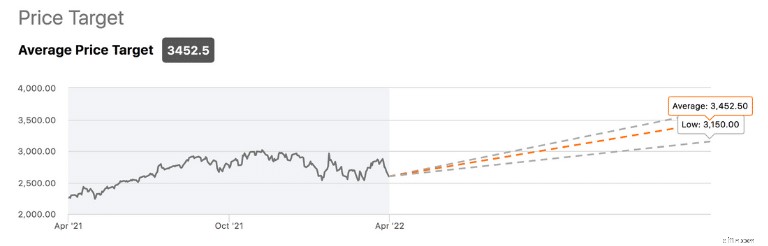
Em outras palavras, com base no preço-alvo (US$ 3.452,50) versus o custo real da ação (US$ 2.595,93), as ações do Google estão, na verdade, subvalorizadas.
É provavelmente por isso que 98% dos analistas da seção de classificações de Wall Street avaliam o Google como uma “compra” ou uma “compra forte”.
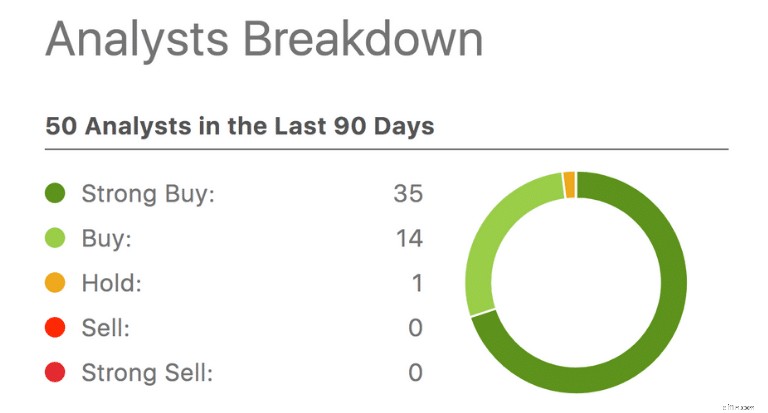
O gráfico abaixo é outro exemplo interessante de funções de preço-alvo.
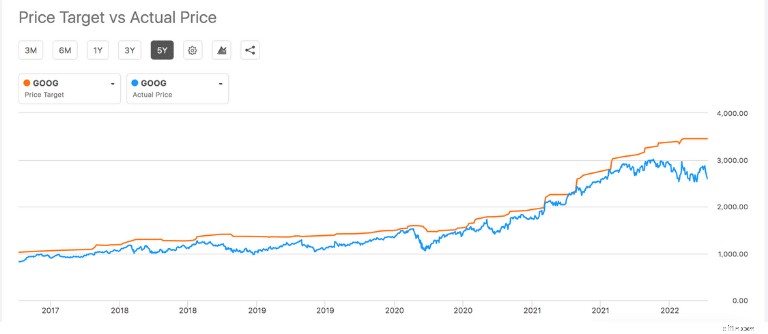
No gráfico Preço-alvo versus preço real, você verá que o preço-alvo (em vermelho) quase sempre foi um pouco mais alto do que o preço real do Google (em azul).
Então, se você é um investidor de valor procurando comprar ações que estão atualmente subvalorizadas, você pode considerar o Google como um investimento.
Agora, você também deve se lembrar do fiasco do GameStop ($GME) no início de 2021, quando os traders do Reddit empilharam dinheiro nas ações falidas do $GME, causando alguns grandes obstáculos financeiros para fundos de hedge e plataformas de investimento como Robinhood.
Sim, algumas pessoas podem ter ganhado dinheiro nesta saga de curta duração, mas provavelmente perderam dinheiro.
Dê uma olhada no gráfico Price Target abaixo, que teria mostrado a qualquer investidor racional que era uma jogada arriscada investir dinheiro em $GME:
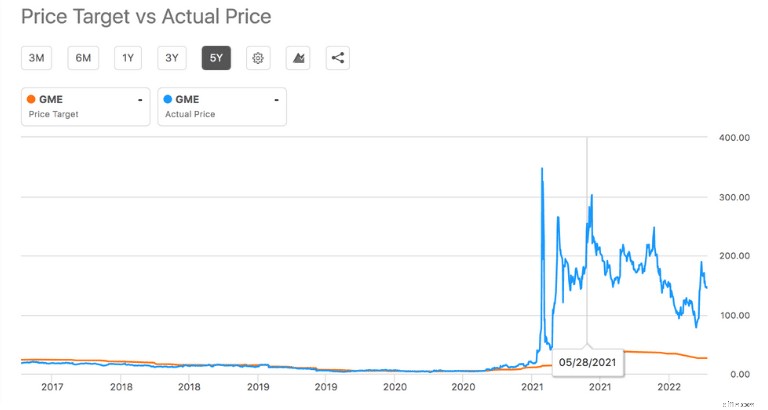
Como você pode ver, o preço-alvo (em vermelho) tem oscilado consistentemente em torno de alguns dólares, enquanto o preço real do $ GME subiu para mais de $ 300 em determinado momento.
Lembre-se de que focar apenas em um ponto de dados, como o preço-alvo, não deve ser o fator decisivo para comprar ou vender uma ação. Um preço-alvo é simplesmente um guia que deve ser considerado em conjunto com outras informações.
Recurso nº 3 do plano Premium:chamadas notáveis
Se você é um investidor intermediário que deseja debater novas ideias de investimento, você pode querer assinar o Seeking Alpha’s Notable Calls.
Você pode assinar Notable Calls e receber ideias sintetizadas e resumidas de empresas de todo o mundo.
Você pode ler a seção Chamadas Notáveis clicando em “Últimas Notícias” e depois em “Chamadas Notáveis”.
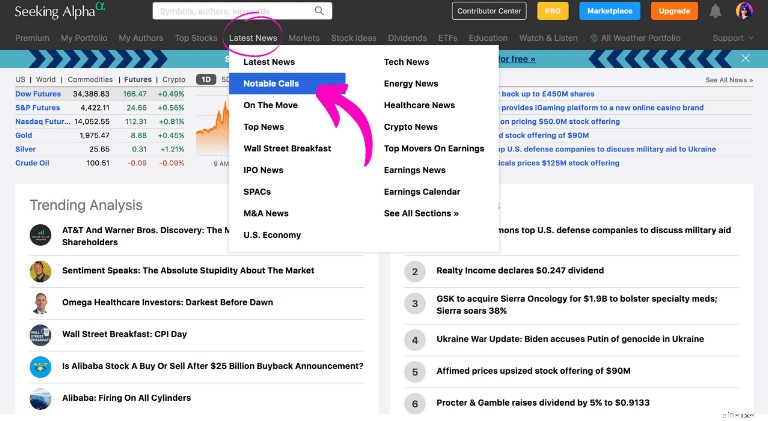
Quando estiver na seção Notable Calls, você poderá explorar diferentes tópicos (desde fibra óptica até marcas de roupas como Levi Strauss).
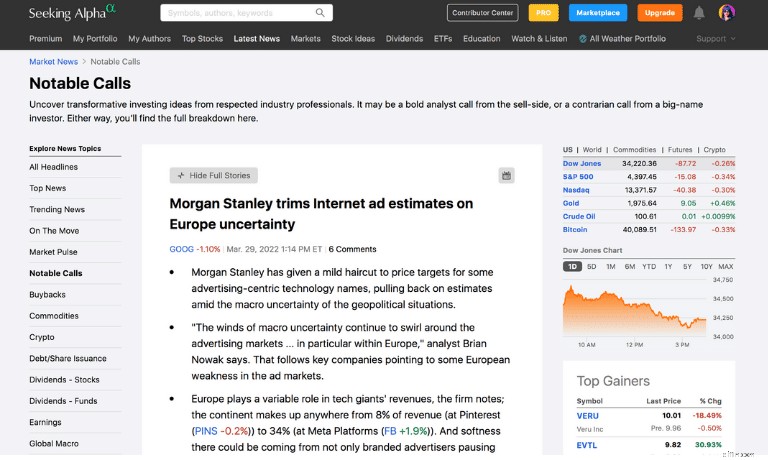
As Chamadas Notáveis não são publicadas diariamente – às vezes pode levar até um mês para que novas informações preencham a seção Chamadas Notáveis.
Como os artigos do Notable Calls não são publicados de forma consistente, continue lendo os artigos dos autores especialistas do Seeking Alpha para reunir mais ideias de investimento.
Recurso nº 4 do plano Premium:Avaliações do autor
Como o Seeking Alpha é uma plataforma de crowdsourcing, não é nenhuma surpresa que cada ação também venha com uma classificação do autor do Seeking Alpha.
Por exemplo, se você der uma olhada na página de resumo da AT&T Inc., verá as classificações das ações de $T divididas por categoria:
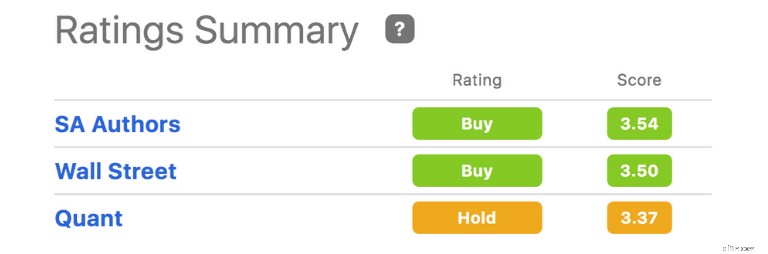
Para saber mais sobre as classificações dos autores do Seeking Alpha, clique no hiperlink azul “Autores SA”.
Aqui, você verá as classificações do autor Seeking Alpha para uma ação como:
- Muito otimista
- Alta
- Neutro
- Baixa
- Muito baixista
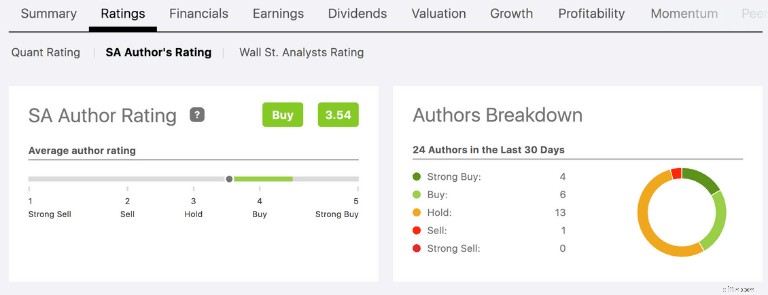
Entre outros fatores, você verá a classificação Seeking Alpha Author Rating e o detalhamento dos autores para cada classificação.
No caso da AT&T, 10 dos 24 autores recomendaram comprar ou comprar fortemente as ações (cerca de 42%).
Além disso, você também pode revisar o histórico de classificações do autor nos últimos anos:
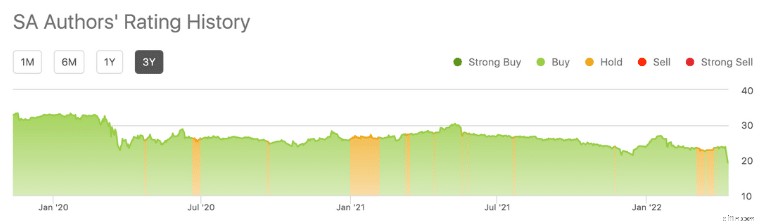
Com base neste gráfico, os autores do Seeking Alpha geralmente recomendam “comprar” ou “comprar fortemente” a AT&T nos últimos 3 anos.
Recentemente, os autores sugeriram “Hold” em vez de comprar.
Por último, você também pode optar por visualizar o histórico de avaliações por autor:
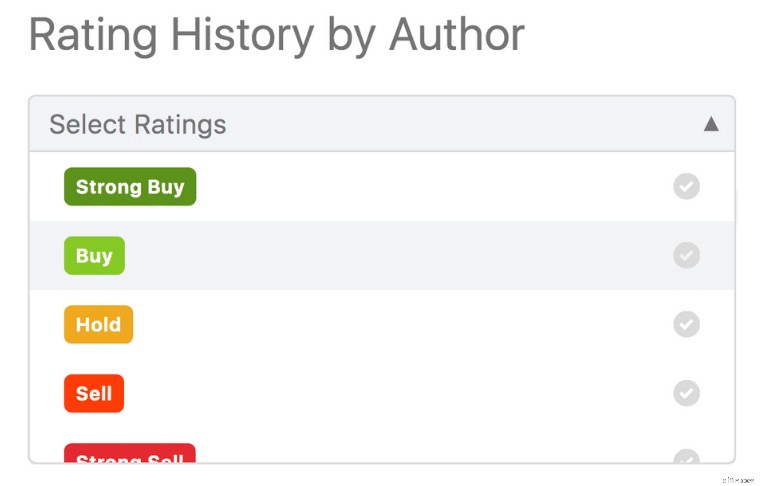
Então, se você está curioso para ver quais autores classificaram a AT&T como uma sugestão de “Compra” versus “Venda”, por exemplo, este é o lugar para fazê-lo.
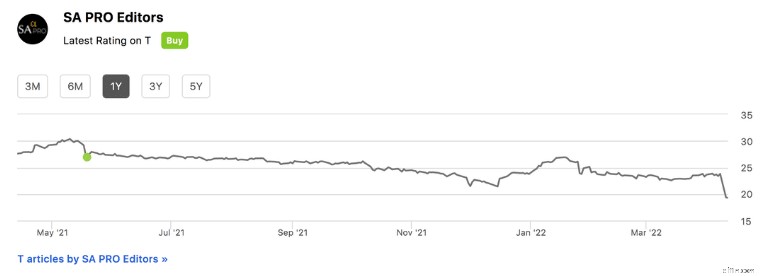
Acima está uma captura de tela de um autor que recomendou comprar ações da AT&T.
Se você está se perguntando por que o autor recomendou fazer isso, clique no hiperlink azul para ler sobre os artigos da AT&T do autor.
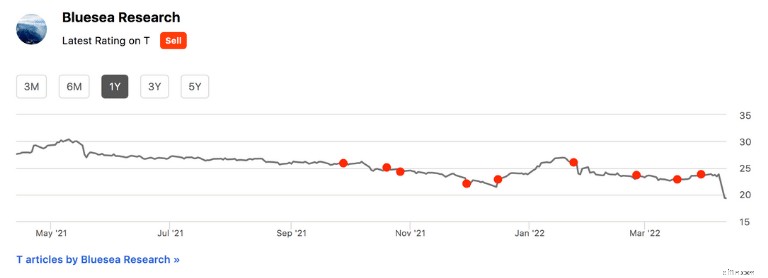
Da mesma forma, se você encontrar um autor que sugeriu vender ações de $T, poderá descobrir quando o autor sugeriu fazê-lo (veja os pontos vermelhos no gráfico relativo ao desempenho das ações de $T).
Novamente, você pode ler artigos desse autor na AT&T clicando no hiperlink azul abaixo do gráfico de vendas do autor.
Recurso 5 do plano Premium: notas de dividendos
Se você é um investidor em dividendos , este é um dos recursos mais legais que você encontrará:a ferramenta Dividend Grade.
Resumindo, a ferramenta Dividend Grade foi concebida para ajudar os investidores a determinar se um dividendo é seguro e se o rendimento dos dividendos será estável, aumentará ou possivelmente diminuirá.
Existem 4 Graus de Dividendos diferentes, que são explicados abaixo:
Segurança de Dividendos
Mede a rentabilidade e estabilidade de um dividendo
Crescimento de dividendos
Mede o potencial de crescimento de um dividendo usando taxas de crescimento históricas e estimadas (inclui receita, fluxo de caixa, lucros, etc.)
Rendimento de dividendos
Mede o rendimento histórico de um dividendo e compara o rendimento com outras ações do mesmo setor para determinar o rendimento futuro do dividendo
Consistência de Dividendos
Mede a consistência dos pagamentos e aumentos de dividendos de uma empresa
Uma razão pela qual os investidores, especialmente os investidores passivos, gostam tanto de dividendos é porque os dividendos são uma forma de renda passiva .
E, quanto mais ações pagadoras de dividendos você comprar, com o tempo, você poderá realmente começar a ganhar algum dinheiro apenas através de ações pagadoras de dividendos.
Dê uma olhada nas atuais classificações de dividendos da AT&T (em abril de 2022):
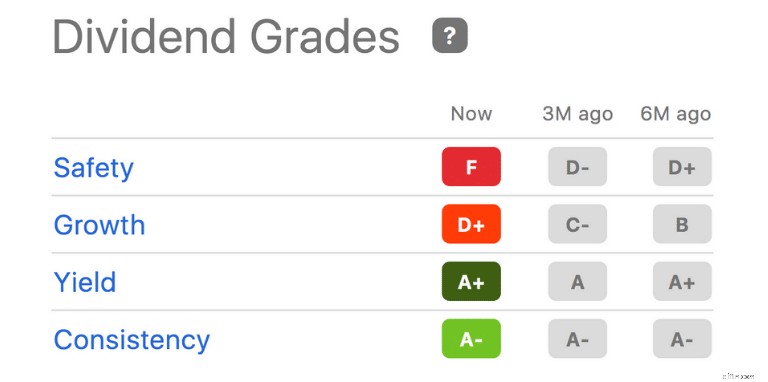
O que eu gosto nas Notas de Dividendos é que você pode ver as notas atuais em comparação com as de 3 meses atrás e até de 6 meses atrás.
Claramente, a segurança dos dividendos da AT&T está em risco. Isto significa que a AT&T poderia diminuir ou até eliminar os seus dividendos.
E é verdade – dê uma olhada no banner de aviso vermelho quando digito $T na barra de pesquisa:
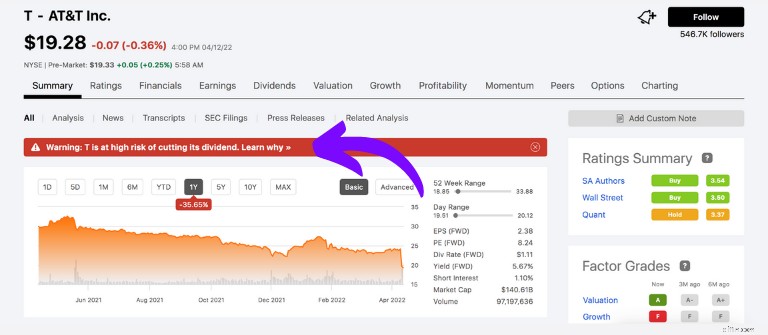
Sem sequer olhar para as classificações de dividendos, sou imediatamente notificado de que a AT&T pode cortar os seus dividendos.
Se quiser saber mais sobre o assunto, basta clicar no banner:
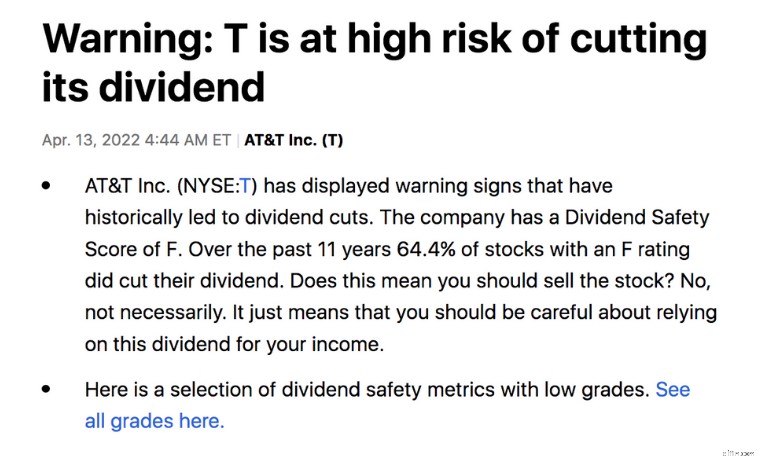
Você será redirecionado para um artigo com uma análise mais aprofundada sobre por que a AT&T poderá cortar seus dividendos em um futuro próximo.
Agora, se você quiser se aprofundar mais em relação às notas de dividendos individuais, basta clicar no hiperlink azul de cada nota de dividendos:
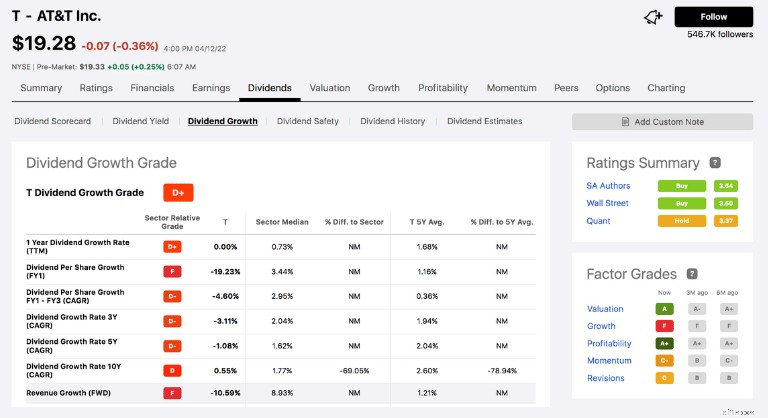
Por exemplo, na captura de tela acima, você verá um trecho de quão aprofundado você obtém apenas lendo sobre o Grau de Crescimento de Dividendos.
Prefiro dar uma olhada na aba Histórico de Dividendos, que se parece com isto:
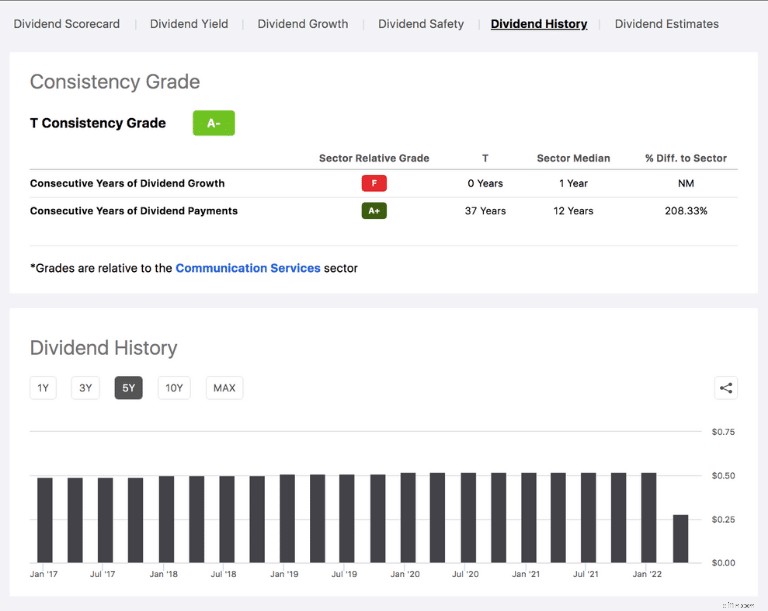
Como você pode ver, nos últimos 5 anos, a AT&T teve um histórico de dividendos muito consistente – mas em 12 de abril de 2022, os dividendos caíram de US$ 0,52 para US$ 0,28.
Esse é um corte muito drástico e normalmente sinaliza uma preocupação para os investidores.
Finalmente, se você quiser saber mais sobre estimativas de dividendos futuros (que não fazem parte das 4 classificações de dividendos originais), você pode clicar na guia correspondente:
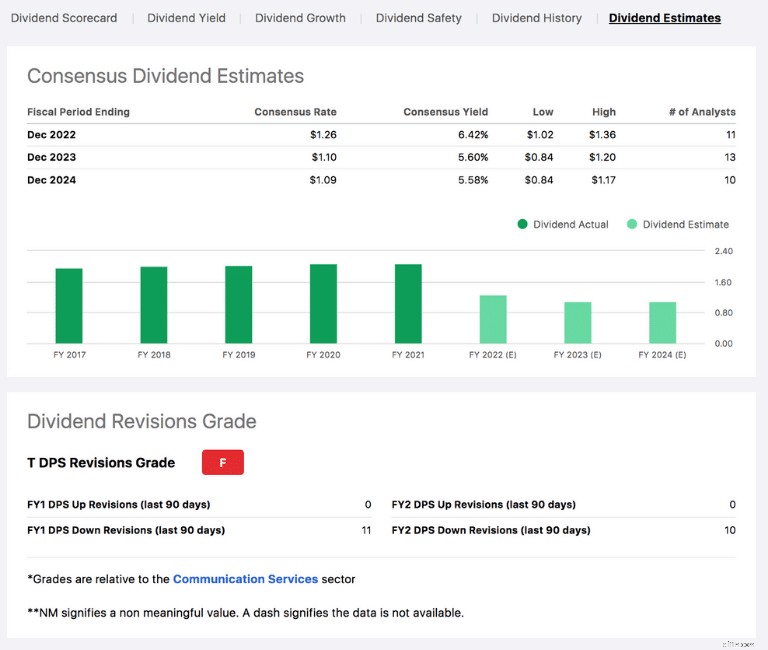
Como você pode ver, as estimativas de crescimento de dividendos não prevêem que o rendimento de dividendos retorne aos níveis originais da AT&T, pelo menos não nos próximos anos.
Recurso nº 6 do plano Premium:Painel de notícias
Se você deseja apenas ler sobre as notícias mais importantes e urgentes da bolsa, sem entrar nos detalhes, use o Painel de notícias.
Você pode chegar ao Painel de Notícias clicando na guia “Últimas Notícias”.
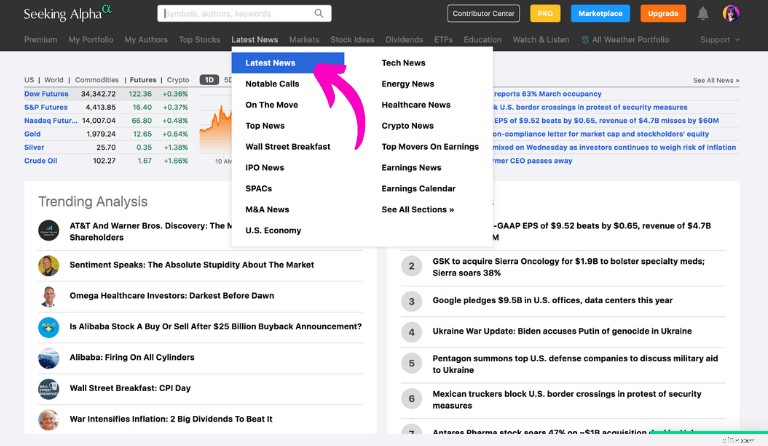
Depois de clicar nas guias “Últimas Notícias”, você será redirecionado para uma página intitulada “Notícias do Mercado”.
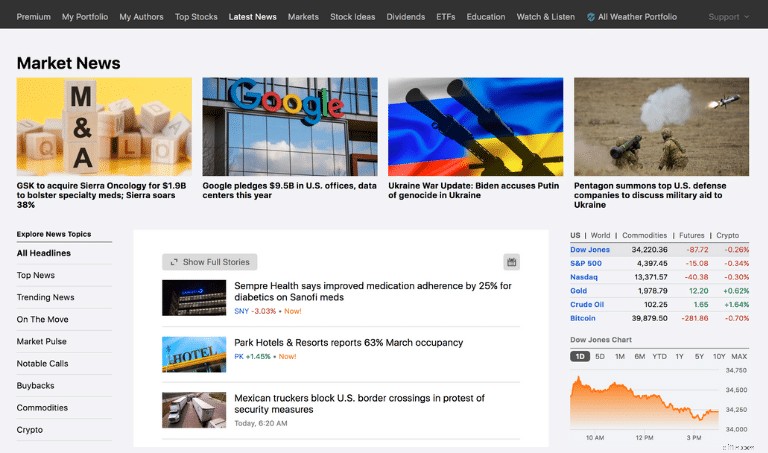
Neste painel, você pode usar o filtro (à esquerda) para explorar tópicos que são relevantes para você.
Você pode até definir um intervalo de datas para concentrar suas leituras em um determinado período.
Recurso nº 7 do plano Premium:Scorecard de fator
Semelhante às Notas de Dividendos, você também pode ver o que o Seeking Alpha chama de Scorecard de Fator.
Em outras palavras, o scorecard é uma ferramenta para ajudá-lo a tomar decisões rápidas sobre considerar ou descartar uma ação, com base em seus critérios de investimento.
O Factor Scorecard usa 5 fatores, incluindo:
- Valor
- Crescimento
- Lucrabilidade
- Momentum
- Revisões de EPS (lucro por ação)
Vamos dar uma olhada no Factor Scorecard para $GME, mais conhecido como Gamestop.
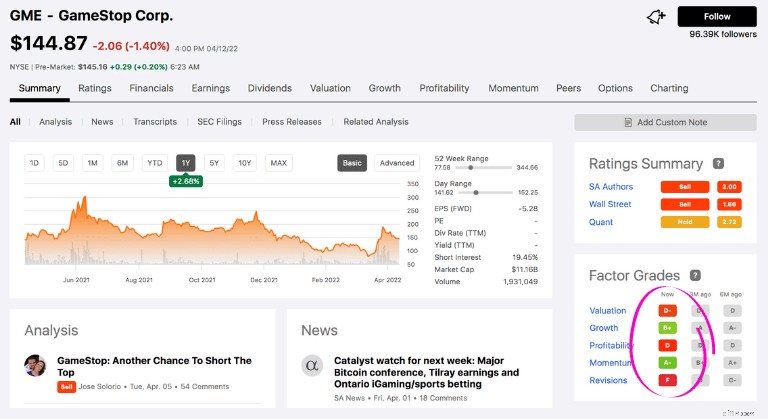
A caixa Notas do Fator é dividida nas 5 categorias que mencionei anteriormente.
A nota de cada categoria também é comparada com a nota anterior de 3 e 6 meses atrás:
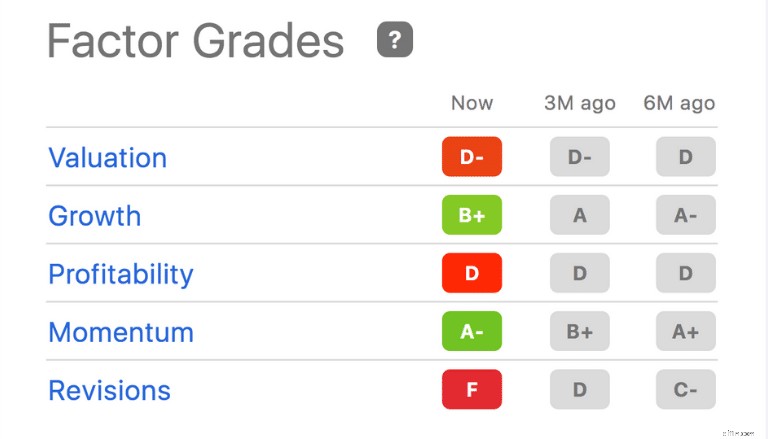
Claramente, as notas dos fatores para Gamestop são bastante abaixo da média. Isso significa que o Gamestop provavelmente não é o melhor investimento – a menos que você se sinta confortável em assumir riscos com ações bastante voláteis.
Se você quiser se aprofundar mais em relação às notas dos fatores individuais, basta clicar no hiperlink azul de cada nota.
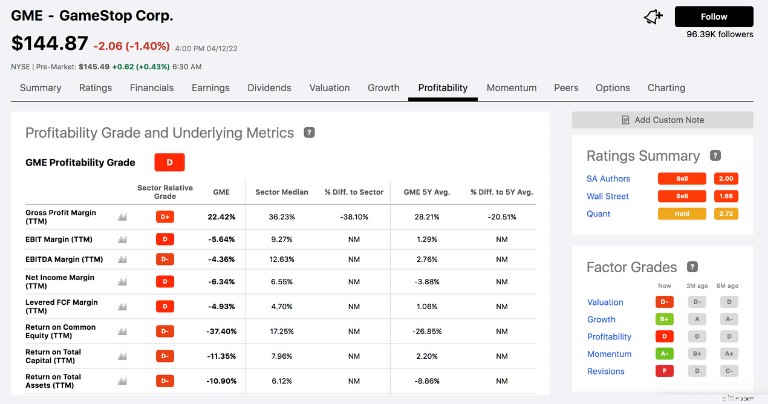
Por exemplo, na captura de tela acima, você verá um trecho de quão aprofundado você obtém apenas lendo sobre a lucratividade do Gamestop.
Também gosto de olhar a aba Momentum para verificar o desempenho passado e o desempenho do $GME em comparação com outros benchmarks – como o S&P 500, por exemplo.
Aqui está um resumo do desempenho anterior da Gamestop em relação a outras empresas do setor:
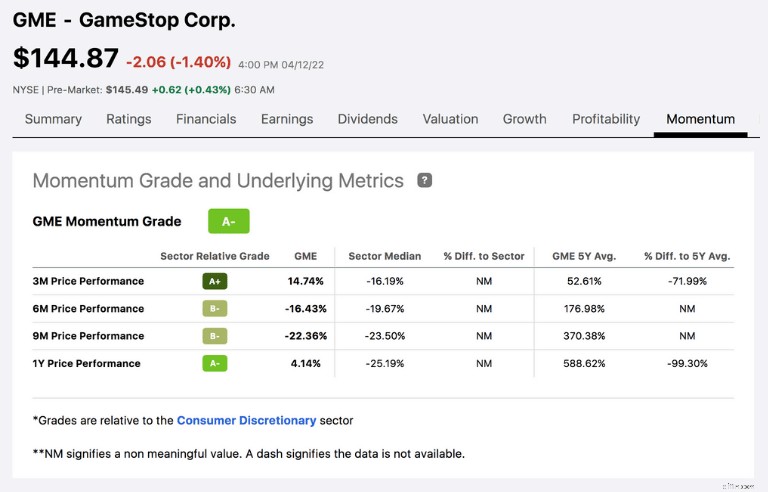
Você também pode verificar o desempenho do preço do Gamestop em relação a determinados benchmarks.
Na captura de tela abaixo, o S&P 500 é usado como referência:
Este gráfico de retorno de preço conta a história completa:
Você pode ver como o Gamestop teve um desempenho consistentemente inferior em comparação com o S&P 500 até o início da saga Gamestop no início de 2021.
Desde o início de 2021, os preços do Gamestop superaram relativamente o S&P 500 – mas será realmente um investimento sólido?
É aí que as ferramentas do Seeking Alpha, como o Factor Scorecard, podem realmente entrar em ação e ajudar a orientá-lo para uma resposta.
Recurso nº 8 do plano Premium:comparações entre pares
Digamos que você esteja pensando em comprar a Tesla, mas não está 100% convencido de que seja a adição certa ao seu portfólio.
É aí que entram as comparações entre pares.
A ferramenta Comparação entre pares é personalizável, para que você possa alterar os tipos de ações que está comparando.
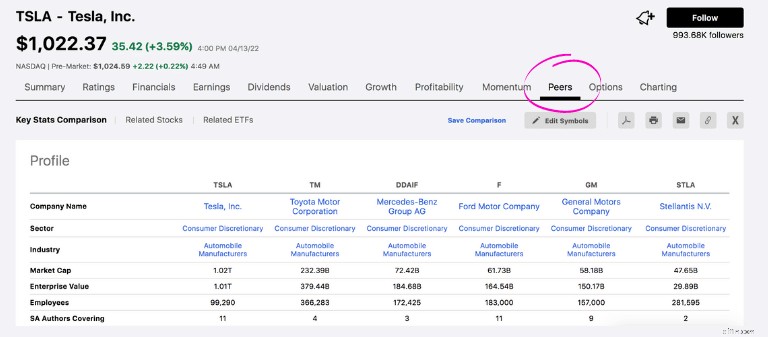
Aqui está um exemplo:primeiro, pesquise o estoque desejado (neste caso, Tesla):
Certifique-se de clicar na guia “Peers”.
Quando estiver na guia “Peers”, você pode ver que o Seeking Alpha já tem como padrão várias ações de pares com as quais você pode comparar o Tesla.
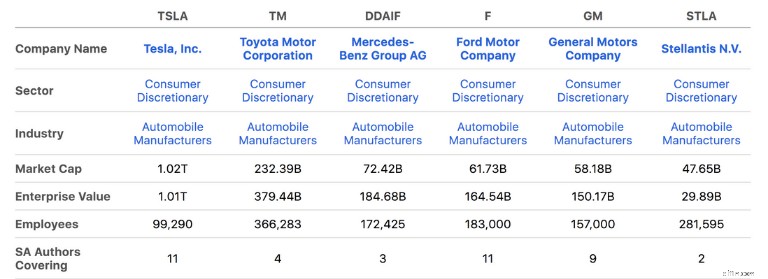
Porém, se você quiser personalizar as comparações entre pares ou até mesmo reduzir o número de pares com os quais está comparando, basta clicar no botão “Editar Símbolos”.
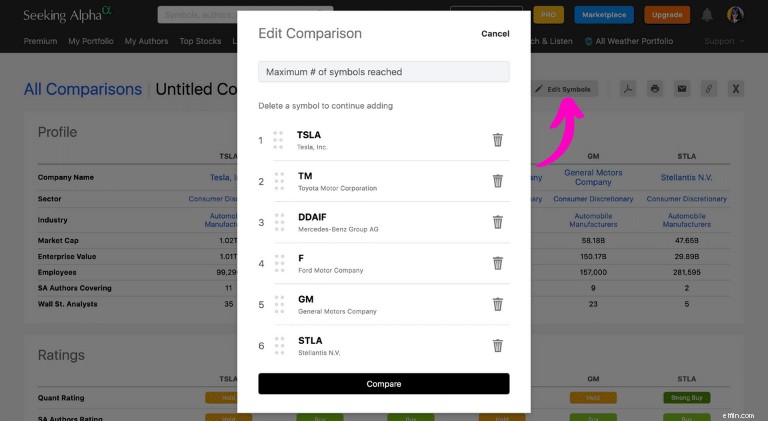
É aqui que você pode personalizar todas as comparações entre pares.
Recurso nº 9 do plano Premium:personalização de alertas
If you really like a stock and want to receive alerts whenever news about that stock is released, you can customize your own email alerts.
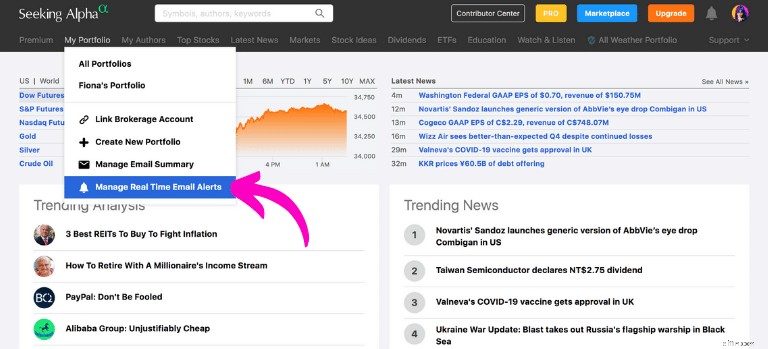
You do this by hovering over the “My Portfolio” tab and then clicking on “Manage Real Time Email Alerts.”
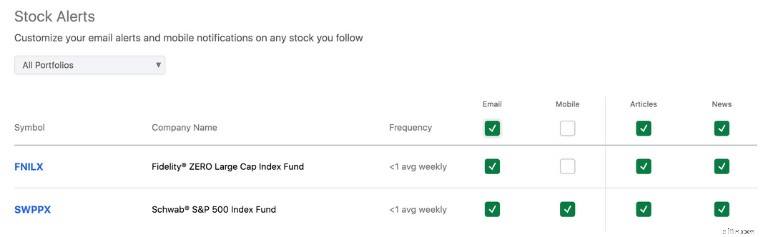
You’ll see a snapshot of your favorite stocks, which you can then select to follow.
The next thing you need to do, is:
- Select the type of alert (article vs. news)
- Select your alert method (email vs. mobile push notification)
I’m a big fan of this alert customization option.
Premium Plan Feature #10:Quantitative Ratings
One of the key features when evaluating a stock on Seeking Alpha should be the Quant Ratings section.
Quant Ratings are based on a computer algorithm with the goal to find the best stocks.
As with the previous Ratings (Wall Street and SA Authors), the Quant Ratings compare the stock to other stocks in the same industry.
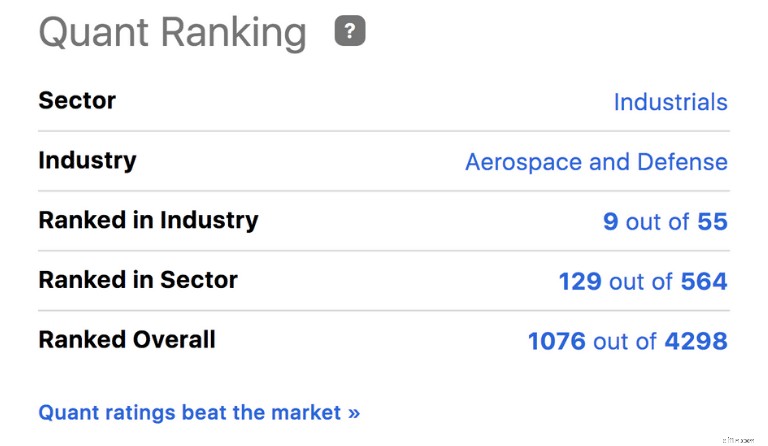
The Quant Rankings use historical information to determine the numbers, as shown in the above screenshot (this case, for Lockheed Martin).
If the Quant Rankings deem a stock to be a top pick, then that stock would be marked as “Strong Buy.”
In Lockheed Martin’s case, the Quant Rankings determined the stock to be a “Hold” for now.
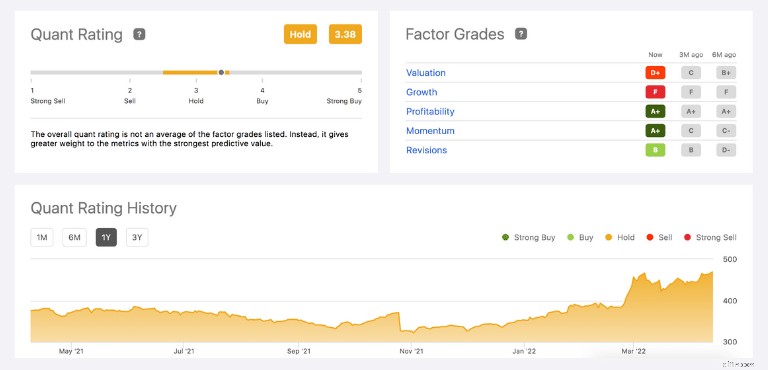
The Quant Ratings and the Factor Grades are both designed and managed by Steve Cress , who has had extensive experience in investment research, hedge funds, and the likes.
The Quant Ratings is what you are looking for – that’s because they can help boost your portfolio performance.
In fact, Seeking Alpha claims that stocks rated as a 4.5 or higher have beat the S&P 500 4x.
On the other hand, stocks rated as 1.5 or lower underperformed the S&P 500, returning roughly 33% of the S&P 500.
Clearly, the Quant Ratings are very helpful.
Premium Plan Feature #11:Stock Screening Tools
As you can see, Quant Ratings are a very powerful tool when evaluating the strength of a stock.
But what if you want to view the top-rated stock, using the Quant tools?
Enter the Stock Screener.
You’ll find the Stock Screener by clicking on the “Top Stocks” tab and then clicking on “Top Rated Stocks.”
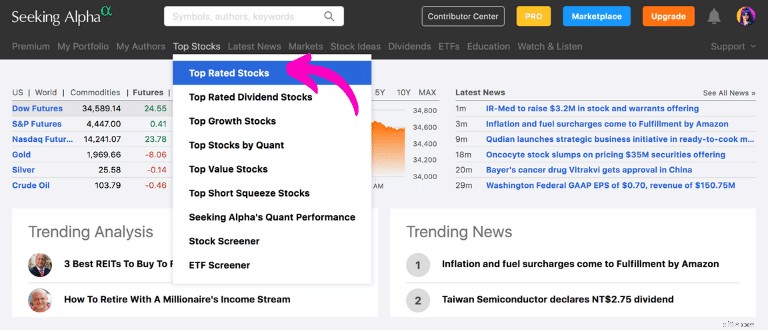
From there, you’ll see a summary of the top rated stocks, and typically the highest Quant Rating is 4.99:
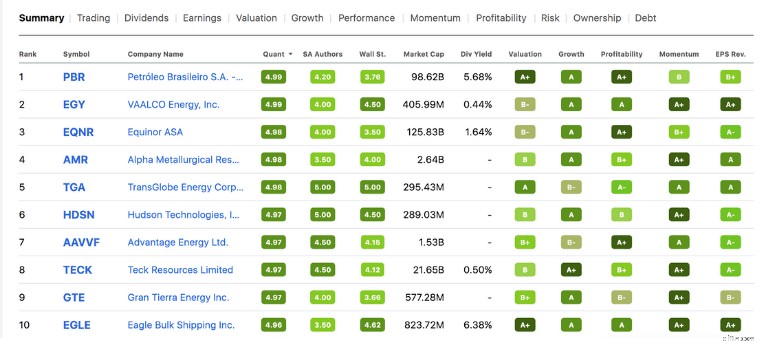
Remember what was said in the previous Quant Ratings section:
Stocks given a Quant Rating of 4.5 or higher have typically outperformed the S&P 500 by up to 4x!
And it’s true that across the board PBR, also known as Petrobas, (in this case the top Quant rated stock) is considered a “Buy” to “Strong Buy” across the board:
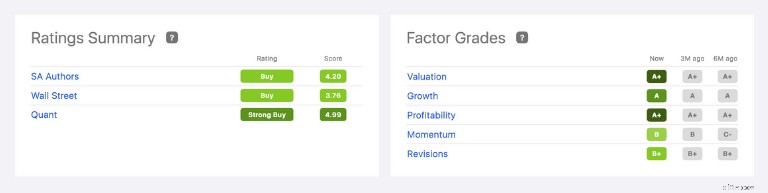
This stock screener is a feature that is currently available to Premium users.
Another neat trick with the Stock Screener?
You can customize your own stocks by using up to 100 different filters!
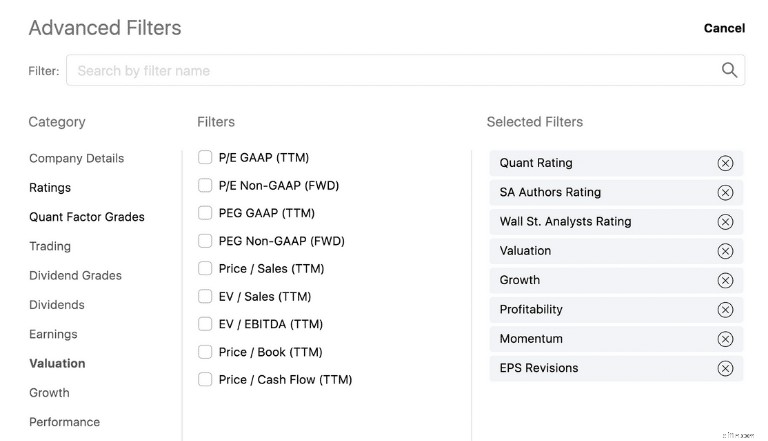
Above is just an example of the many different filter applications you can use to customize your stock screener.
Based on historical performance, stocks ranked as 1.5 or lower drastically underperformed the S&P 500.
Premium Plan Feature #12:Wall Street Consensus
If you want to follow what sell-side analysts have to say in terms of buying, holding, or selling a stock, then check out the Wall Street Ratings.
Instead, Seeking Alpha collects data from the Wall Street analysts to determine whether a stock is rated as:
- Very Bullish
- Bullish
- Neutral
- Bearish
- Very Bearish
The reason why Wall Street Ratings can be helpful for people like you and me is that these rankings should (in theory) be objective and neutral.
To review the Wall Street Ratings of a certain company, just type in the company name or ticker symbol in the “Search” bar on the top, and then look at the information on the right of the screen.
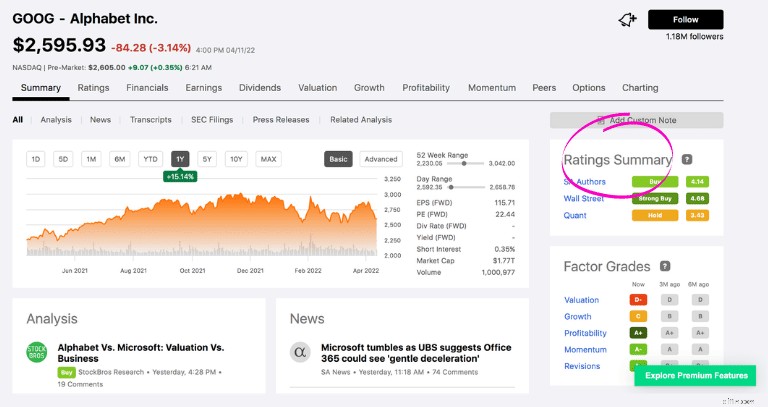
When you look at the right-hand side, you’ll see the “Ratings Summary” outline, with 3 titles:
- SA Authors
- Wall Street
- Quant
To learn more about the Wall Street rating, click on the “Wall Street” blue hyperlink.
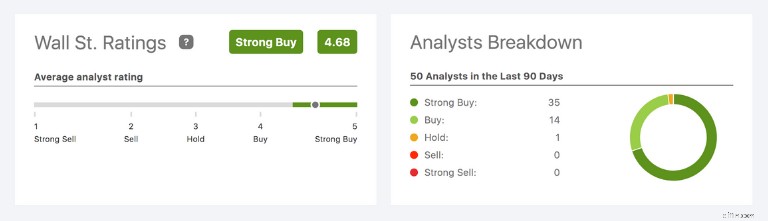
Among other factors, you’ll see the Wall Street average analyst rating and the Analyst Breakdown for each rating.
In Google’s case, 49 out of 50 Wall Street analysts recommended to Buy or Strongly Buy the stock (that’s 98% of analysts!).
Furthermore, you can also review the Wall Street Ratings’ track record for the past few years:
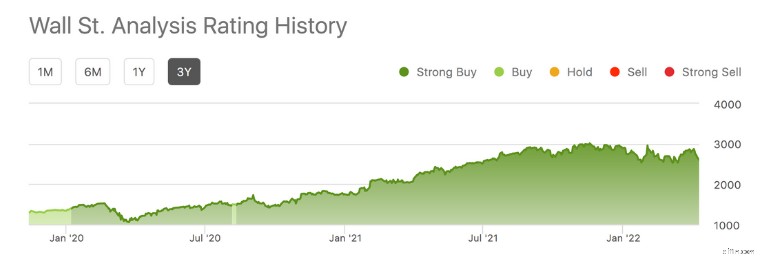
Based on this graph, Wall Street analysts have recommended to Buy or Strongly Buy Google over the past 3 years.
Lastly, you can also see how the Wall Street analysts’ opinions have changed over time with the Recommendations Chart (found at the bottom of the page):
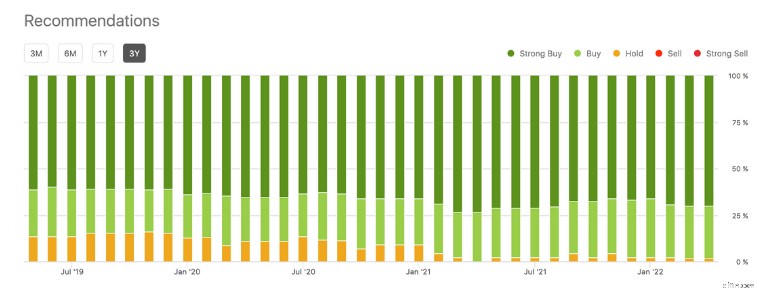
It appears that in 2019 and early 2020 more analysts recommended to hold Google, while starting in 2021, virtually all analysts recommended to buy Google.
Premium Plan Feature #13:Data Visualization Charts
Since I’m a very visual person, one of my favorite features on Seeking Alpha is the data visualization of the charts.
In fact, Seeking Alpha has a specific tab named “Charting” that you can access to view the data in an aesthetically pleasing manner:

Once you click on the “Charting” tab, you can even customize the data you want to view.
For example, you can compare one stock’s performance (in the case, Gamestop) to another stock or benchmark like the S&P 500:
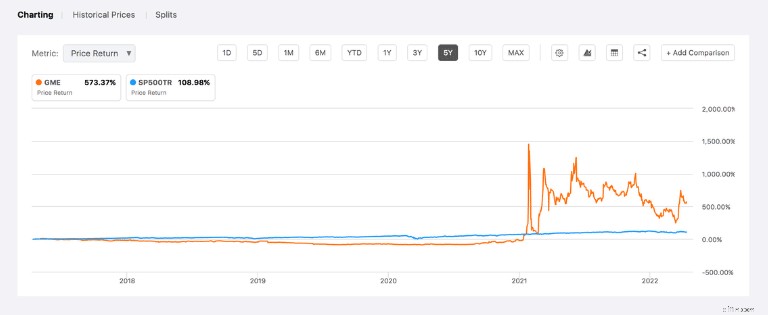
In this custom comparison, you can see that the S&P 500 has typically outperformed Gamestop until early 2021.
If you want to add additional stocks or funds to compare, you can do so, as well:
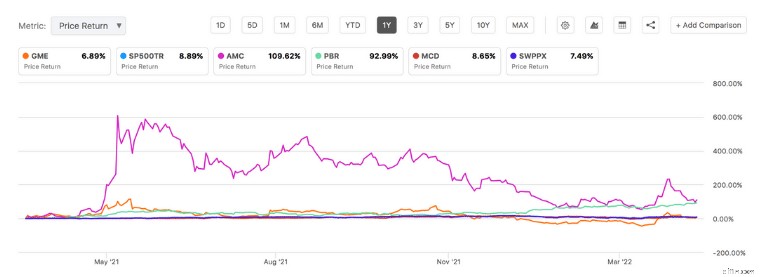
Another neat way to customize your data is changing the format of the data presentation – you can select:
- Area
- Columns
- Line graph

If you’re happy with the data visualization chart you created, you can also copy to clipboard, download, or copy the link to your chart for future reference.
Premium Plan Feature #14:Earnings Calls
If you’re a Seeking Alpha member, you have exclusive access to earnings calls transcripts.
In most cases, you can expect to have an earnings call at the end of the first 3 quarters.
At the end of the 4th quarter, you’ll receive both an annual report as well as a quarterly report.
If you’re busy at the time of the actual earnings call, you can always count on Seeking Alpha to have a transcript available – both audio and written versions.
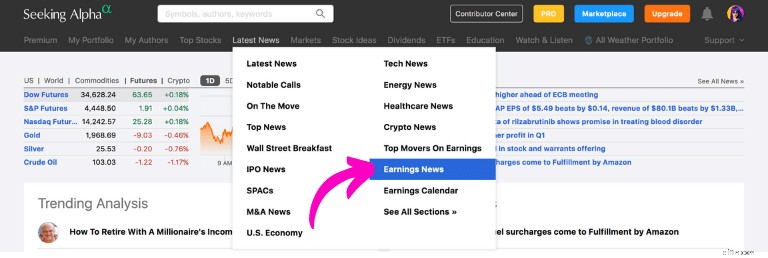
You can access the earnings reports of any publicly-traded company by hovering over “Latest News” and then clicking on the “Earnings News” button.
You can also access a schedule of the upcoming earnings calls by clicking on the “Earnings Calendar.”
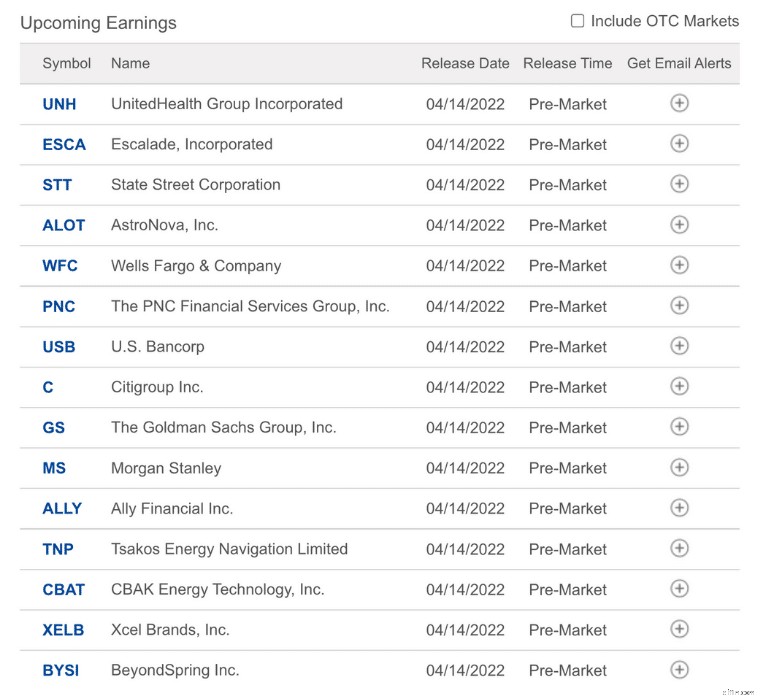
Once in the Upcoming Earnings tab, you can select which company you want to listen to and you can even sign-up for custom email alerts by clicking on the “+” sign.
If you’re looking up one of your favorite companies, let’s call it Amazon, then you just have to click on the “Earnings” tab for that stock:

From there, you can click on the “Transcripts” tab and look at all previous transcripts:
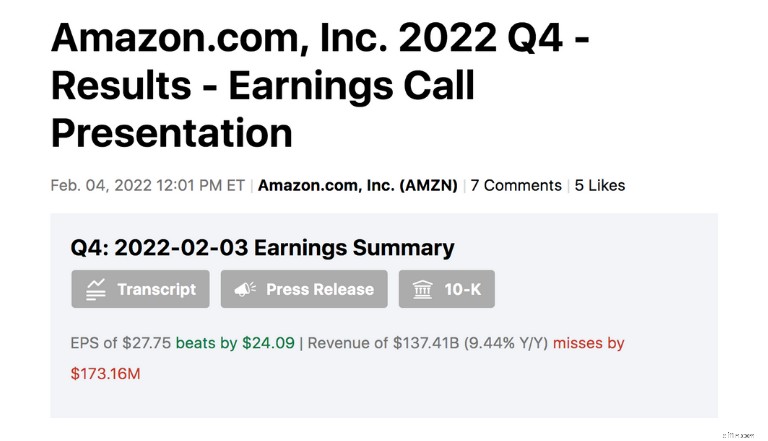
Depending on the company you review, you can also access a PDF file with slides that highlight the company’s key points.
Premium Plan Feature #15:Unlimited Access to Articles
With the Premium (and of course Pro) memberships, you also have unlimited access to exclusive articles written by industry professionals.
Since there is so much information, you can filter out the articles in several different ways.
First, you can simply access your home page and review the “Trending Analysis” of the day or the “Trending News” of the day.
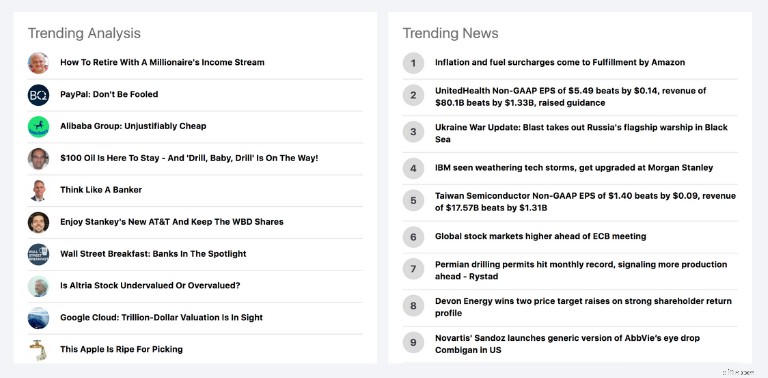
If you want to review articles written by various authors about just 1 particular stock or fund, then just type in the stock name or ticker symbol into the Search Bar.
From there, click on “Summary” and then on “Analysis” so you can see the various articles offered by authors on that stock.
Here’s an example of articles written about the Tesla stock:
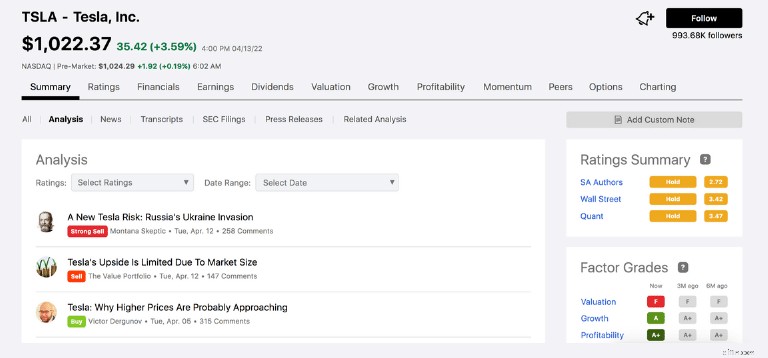
If you want to read articles from authors who advocate buying, selling, or holding, you can customize your ratings by clicking on the “Select Ratings” drop down box.
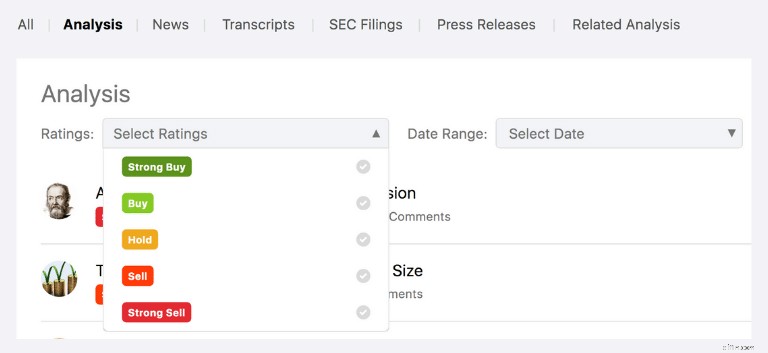
While most articles do focus on US-based public companies, there are some articles that also focus on alternative investments as well as international companies.
Premium Plan Feature #16:Create Your Own Mock Portfolio
As a Premium Seeking Alpha user, I’m a very big fan of creating your own portfolio in Seeking Alpha.
If you’re dedicated to kickstarting your kids’ financial future, then you may also want to check out the Greenlight Debit Card , which can do wonders.
You can set up your own mock portfolio in Seeking Alpha by hovering over “My Portfolio” and then clicking on “All Portfolios.”
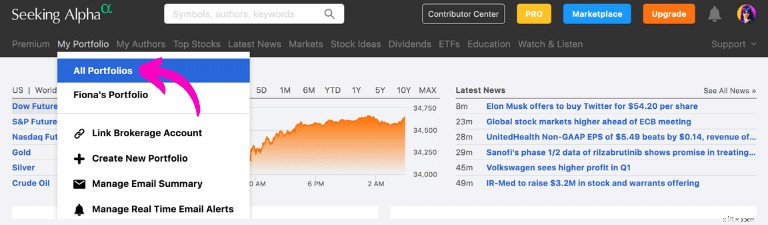
From there, you can click the button titled “+ New Portfolio.”

This will allow you to add a new, mock portfolio while using the Seeking Alpha platform.
You can give that portfolio a title and then you can either link your outside brokerage account to this portfolio or add your own stocks to the portfolio.
For the purpose of this section, we’re going to click on “Create Portfolio.”
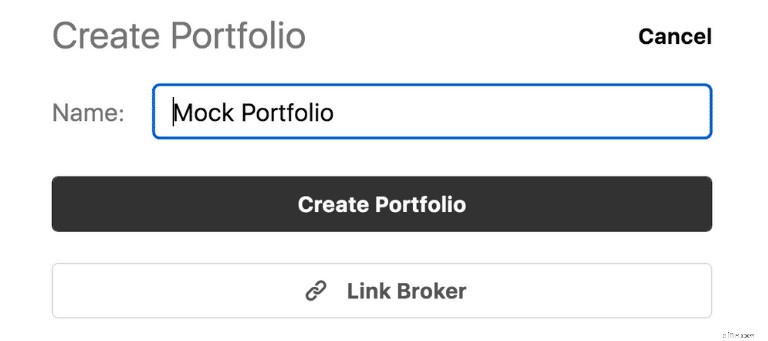
Once you’ve created your portfolio, you can start adding ticker symbols to complete your portfolio.
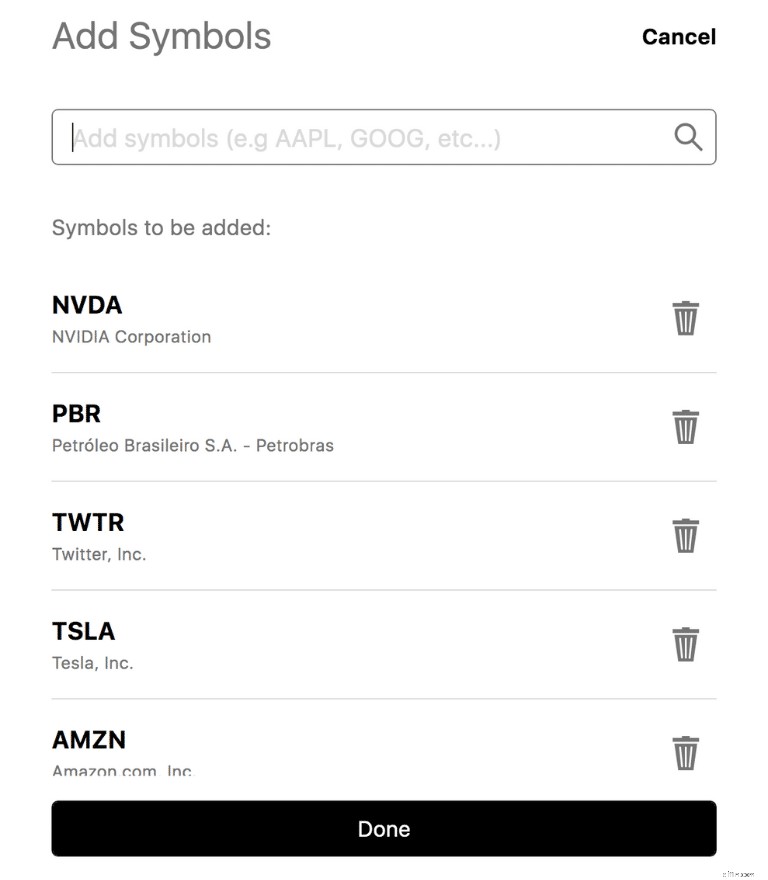
Once you’re happy with your portfolio construction, you can click “Done.”
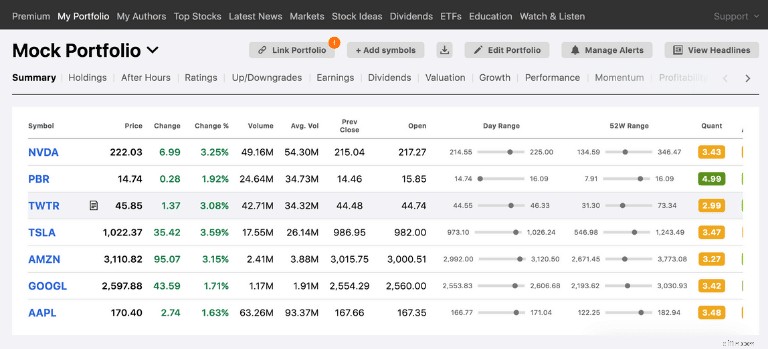
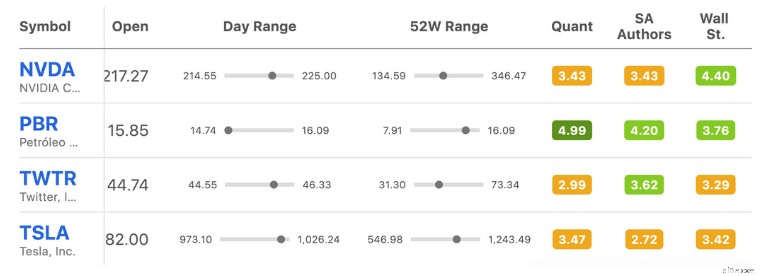
Seeking Alpha does a fantastic job breaking down each stock in your mock portfolio by using multiple different factors.
You can even compare the Quant, SA Authors, and Wall Street ratings to each other:
If you click on the “View Headlines” button in your portfolio, you’ll see an assortment of articles written just for your specific stocks in your portfolio:
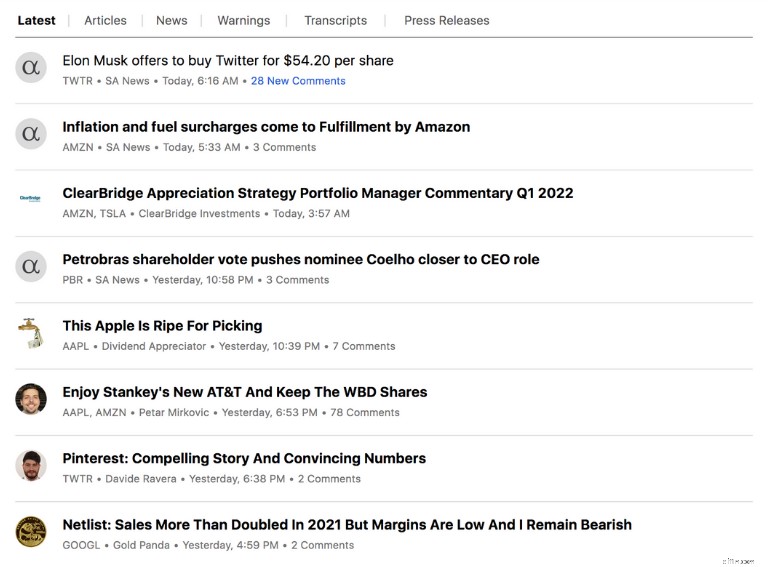
Finally, one of the other notable features of your Mock Portfolio is the custom alert and notification button.
When you click on “Manage Alerts” you can customize your alerts based on:
- Content
- Delivery
- Price alerts
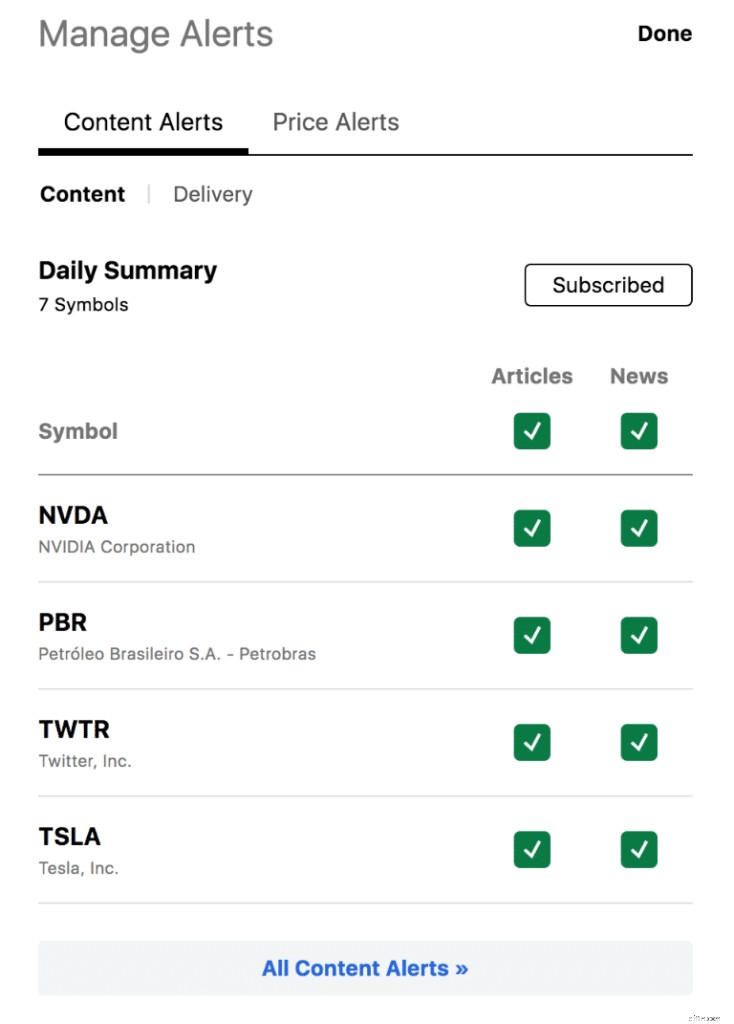
So, if there is an update on a stock like Twitter for example, you’ll receive real-life notifications to your email or phone – depending on the delivery method that you select.
You can also manage your price alerts, which I will review in a separate section here.
Premium Plan Feature #17:Manage Your Custom Price Alerts
If you’ve already created your mock portfolio through Seeking Alpha (or even if you’ve already connected your outside brokerage account with Seeking Alpha), you can set custom price alerts.
For example, if you own shares of Twitter and the current price Quant Rating is 2.99, which is nearing a sell territory, then you may want to filter for other stocks that might be deemed a “Strong Buy.”
Here’s how (this is assuming you’ve already set up your own portfolio in Seeking Alpha. If not, then please reference the previous feature):
First, access your portfolio and click on “Manage Alerts.”
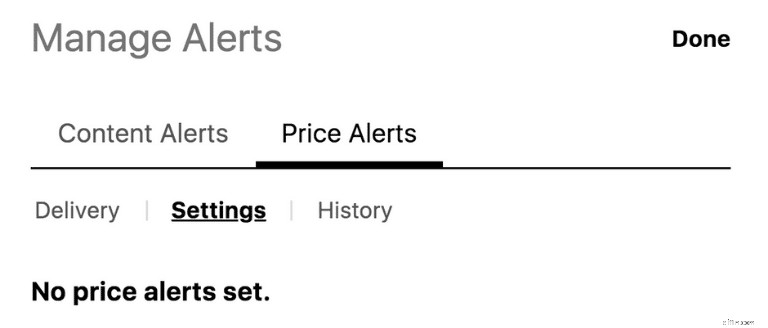
Then, click on “Price Alerts” and then on “Settings.”
From there, you’ll want to click on “All Price Alerts,” which you’ll find at the bottom of the dialogue box.
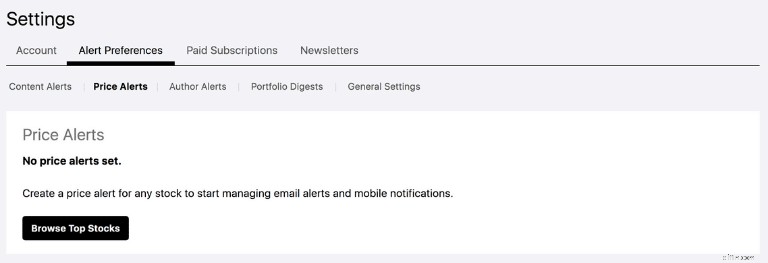
From there, click on the “Browse Top Stocks” button.
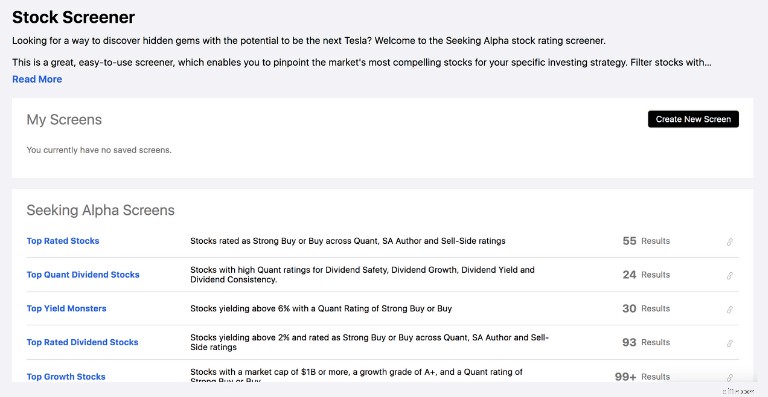
You can either continue using the Seeking Alpha Screens (and there are many) or you can create your own, custom screen.
If you create your own custom screen, you’ll be brought to a window like the one below:
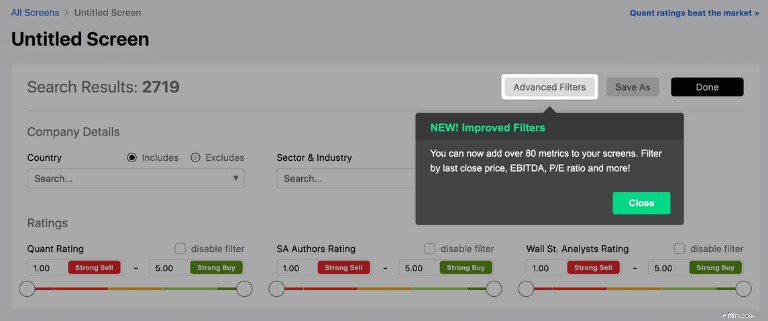
You can customize your stock screener by adding up to 80 different filters.
For example, if you want to screen for all stocks that are assigned a 4.00 out of 5.00 rating for the Quant, SA Authors, and Wall St. Analysts, this is the place to do so.
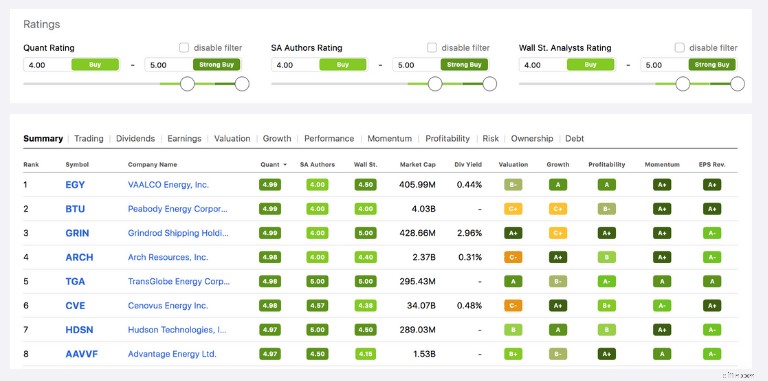
Take some time to experiment with the screening tool, because there is just so much information.
However, if you’re ever wondering why or how to filter for the best stocks for your portfolio (or your child’s portfolio), this is probably the tool you’ll want to use.
Premium Plan Feature #18:Downloadable Financial Statements
If you’re an investor who really enjoys digging deep into the financials for each company before trading its stock, you’ll be happy to know that the Premium tier also comes with downloadable financial statements .
In fact, you can access up to 10 years worth of financial statements to download, review, and analyze.
Just search your favorite company and click on the “Financials” tab.
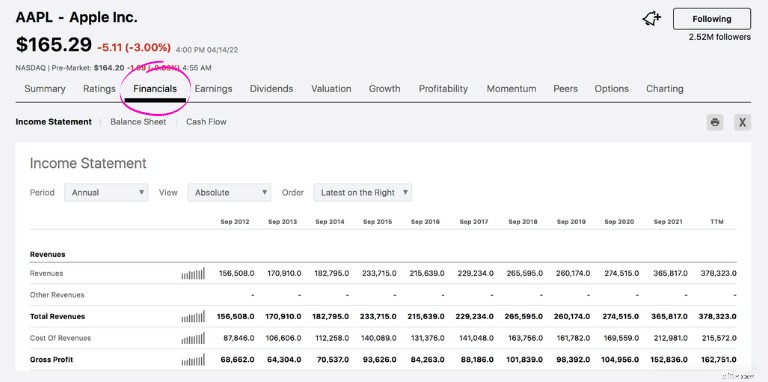
From there, you can either review the numbers or for a more visual approach, just hover over the line graph for each data set:
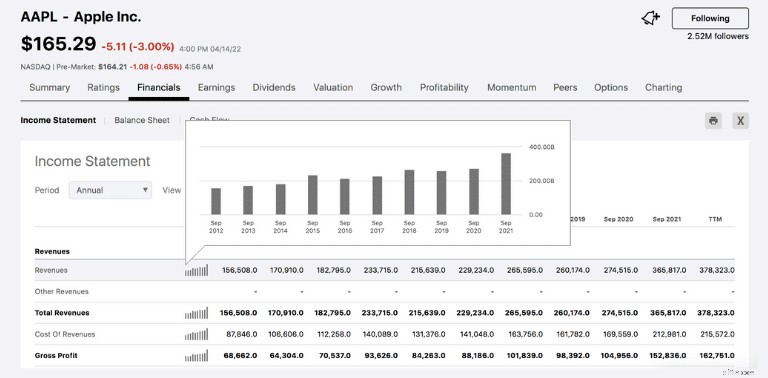
If you want to review the numbers in even more depth, you can click on the print icon or the “X” icon at the top, right of your screen to either print to PDF or download via Excel.
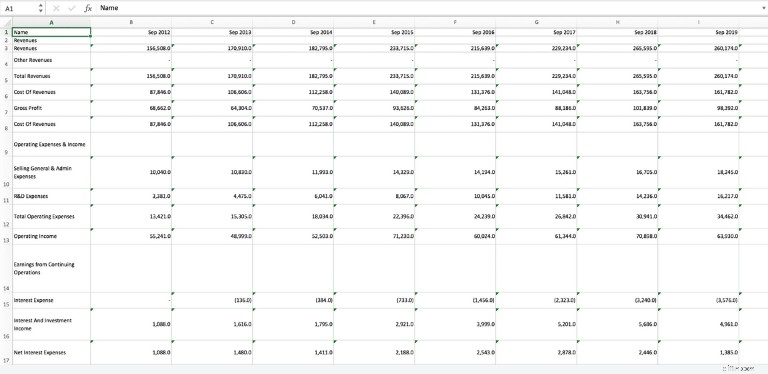
So depending on how in-depth you want to go, Seeking Alpha really gives you a lot of options to analyze your stocks.
Premium Plan Feature #19:Stock Performance Comparison Tool
Ever wonder how your current stocks compare to other stocks in the marketplace?
Take a look at the Stock Performance Comparison Tool – which is one of my favorite tools.
Just search your favorite stock and then click on the “Charting” tab.
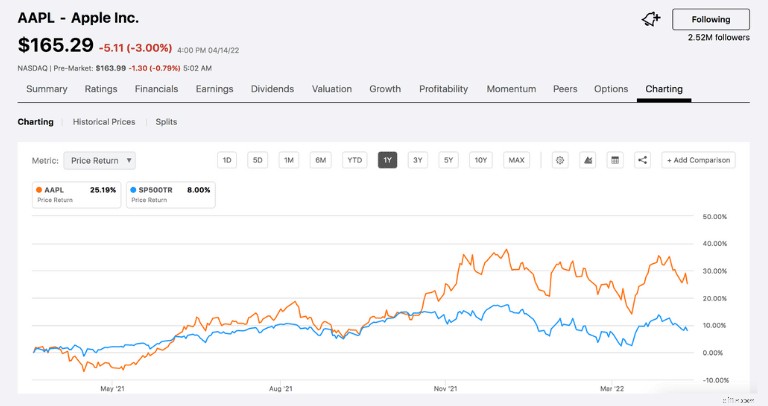
The default comparison is your stock (in this case, Apple) and the S&P 500.
However, if you want to know how apple is doing compared to another individual stock in the tech or a similar sector (like Tesla), then just click on the “+ Add Comparison” button and add your favorite stock:
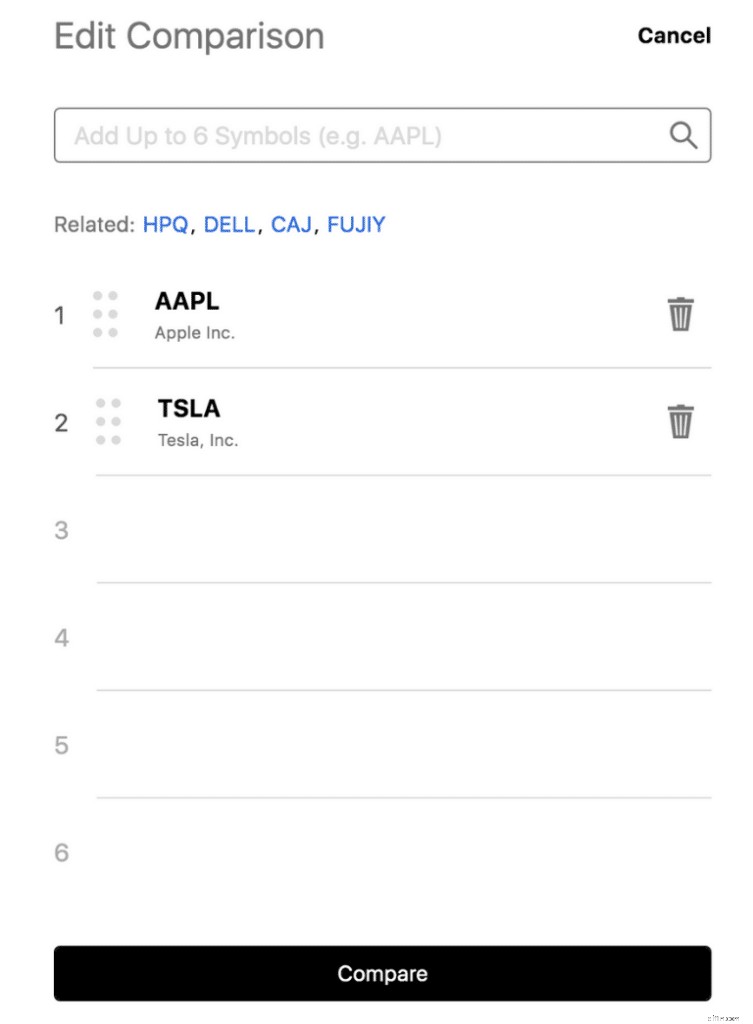
Now take a look at the comparison of Apple stock versus Tesla stock over the past 3 years:
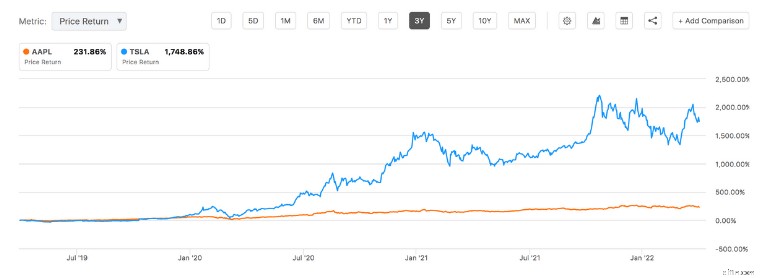
While this stock performance comparison chart shouldn’t be the only tool you should use to determine whether a stock is worth a purchase, it can certainly be a helpful guide.
Premium Plan Feature #20:Link Your Outside Investment Account
Lastly – but certainly not least – another cool feature with the Premium Tier is that you can link your outside investment accounts to your Seeking Alpha account.
Remember that you’ll receive access to Seeking Alpha’s quant comparison tool, the Wall St. Analyst ratings, and the SA Author rankings – along with customizing real-life alerts for each of the stocks you hold.
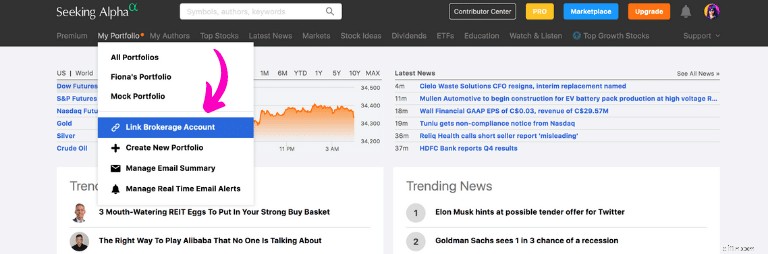
To start linking your outside accounts, just navigate to your main menu, hover over “My Portfolio” and then click on “Link Brokerage Account.”
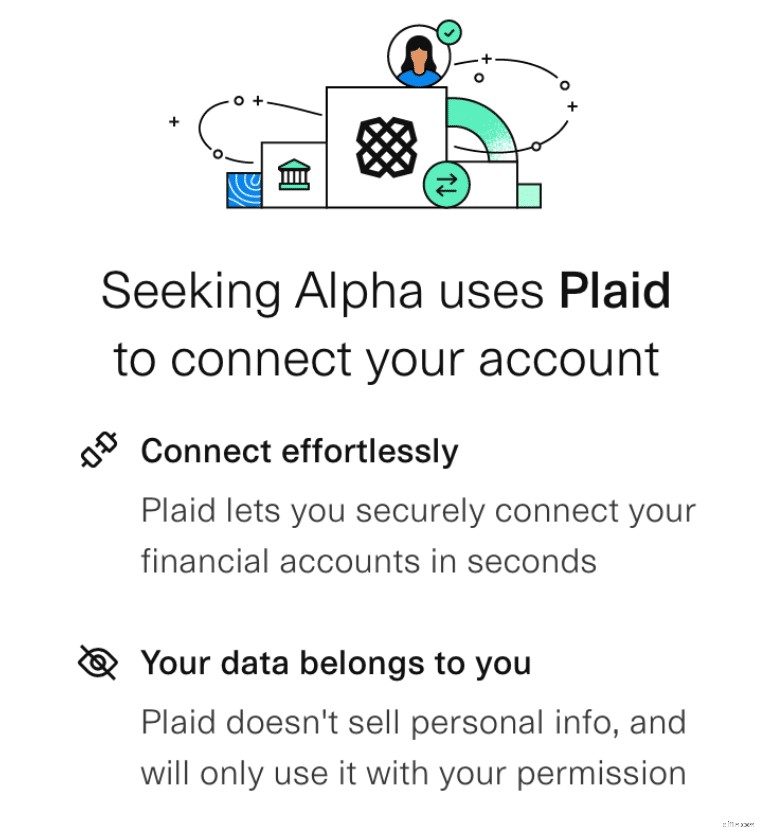
Any outside brokerage accounts that you link will be connected using the secured encryption software, known as Plaid.
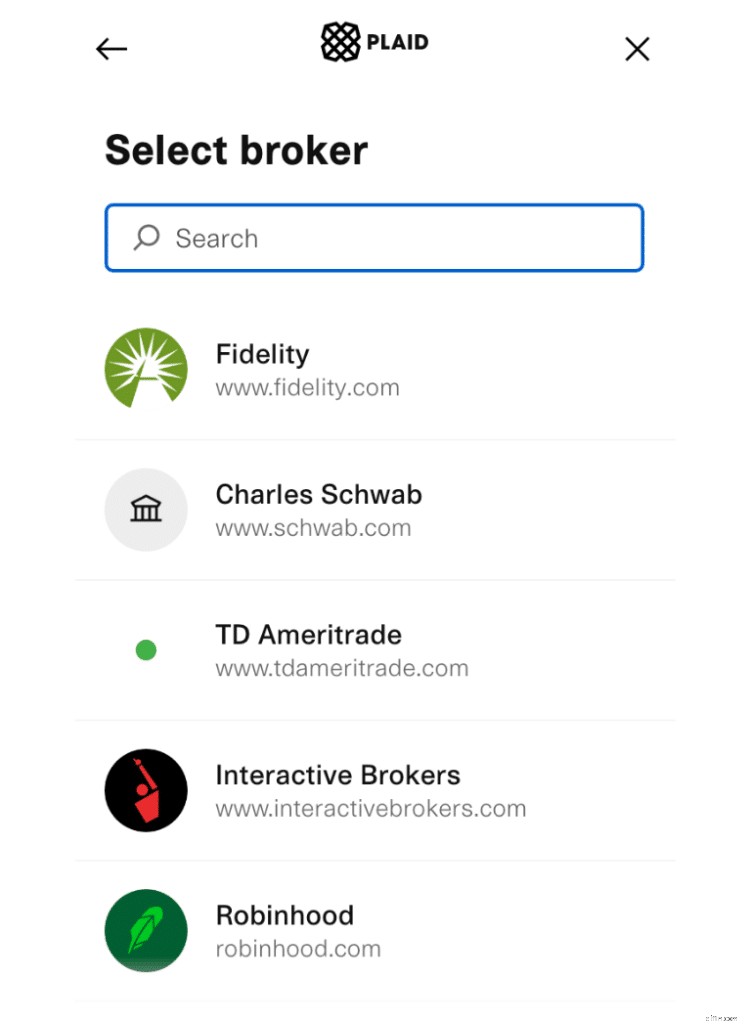
You can select a number of different brokers, such as:
- Acorns
- Fidelity
- Vanguard
- Robinhood
- Charles Schwab
Even if you don’t see your brokerage firm immediately, you can either search for your brokerage firm or sometimes even input the information manually.
Once you’ve established a link to your brokerage account, you can do the following:
- Track your account value
- Sign-up for real-life stock alerts
- Assess the holdings in your accounts
- Aggregate your total liquid net worth in one place
Keep in mind that Seeking Alpha is an informational platform only – you cannot place investment trades on Seeking Alpha.
So to buy or sell stocks in your linked brokerage account, you’ll actually have to sign in to your own investment account.
Recommended Reading:Best Investment Apps
Is Seeking Alpha Premium Right for You?
Seeking Alpha Premium could be right for you if you:
- Enjoy fundamental research
- Want the latest stock market news
- Have some knowledge about investing
- Like to review in-depth stock analyses
- Want to be more involved in the portfolio allocation
Being a Premium Plan member myself, my favorite part is that you can use the Premium tier for as much or as little research as you want.
For example, if you’re thinking about adding Build-A-Bear Workshop, Inc. (BBW) to your portfolio, and you want some additional advice from industry experts.
In this case, just check out the BBW stock rankings in the Ratings Summary section.
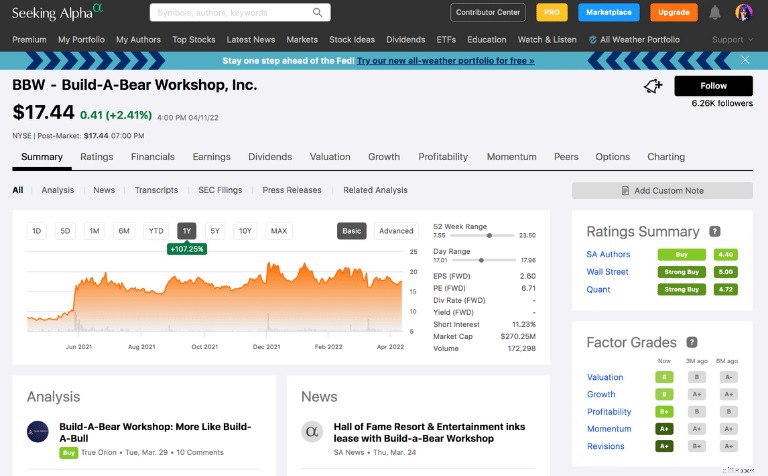
You’ll see that on 3 different instances, the BBW stock is considered a Buy to a Strong Buy opportunity:
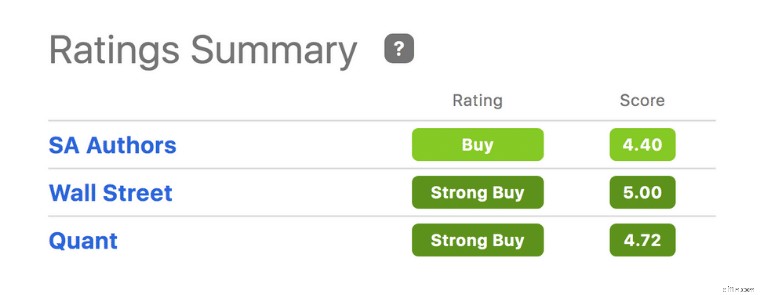
Now, if that’s all the reassurance you were looking for, you can move on and not look back.
However, if you want to drill into more depth with the Build-A-Bear Workshop, Inc. stock, Seeking Alpha lets you do as much fundamental analysis as you want.

Conclusão:
The Premium Plan gives intermediate investors the best of both worlds:Reassurance on which stocks to buy, hold, or sell while also going into as much analytical depth as possible.
Seeking Alpha Pro Plan
Just like the Premium Plan, you can also start a 14-day free trial period with the Seeking Alpha Pro Plan .
If you enjoyed the Pro Plan trial period, then you can pay for the Pro Plan in 2 ways:
Monthly Plan
$299.99/month
Annual Plan
$2,400 (or $199.99/month, as advertised)
It appears that the default case for Seeking Alpha is charging the full year’s worth of premiums upfront (so $2,400 in this case).
One of the best benefits to the Pro Plan is that you receive VIP access and Editorial Concierge, customized to your needs.
Keep reading to find out more about the key features of the Pro Plan.
Seeking Alpha Pro Features
In this section, I’ll explain in detail some of the top Pro Plan features and how you can benefit from each (keep in mind that the Pro Plan already comes with the Premium Plan features).
Below is an overview of the additional Seeking Alpha Pro Plan features:
- Ad Free
- Idea Screener
- VIP Editorial Concierge
- Pro content and newsletters
- Top Ideas Recommendation List
Pro Plan Feature #1:Ad-Free
With the Seeking Alpha Pro Plan, your entire user experience will be ad-free.
Remember that the Limited Access version does come with ads and the Premium version offers an ad-lite user experience.
Pro Plan Feature #2:Investment Screener
The Seeking Alpha Pro platform gives you the chance to be as specific as possible when filtering your investments.
You can filter your investments by:
- Investment style
- Localização geográfica
- Market capitalization
If you know what you’re doing and if you know what you’re looking for, then this investment screener can be used to your advantage.
Pro Plan Feature #3:VIP Editorial Concierge
If you want the bells, the whistles, and the exclusive VIP treatment, then you should consider the Pro Plan.
The editorial team works directly with Pro level subscribers to filter out and pinpoint ideas that fit to your investing needs, style, and preferences.
Pro Plan Feature #4:Pro Content and Newsletters
If you want daily short summaries of the top 1% of the Seeking Alpha content, then your Seeking Alpha Pro level subscription will give you that VIP treatment.
Pro Plan Feature #5:Top Ideas Recommendation List
As a Pro member, you’ll have Seeking Alpha’s industry experts send you a weekly list of their hand-picked top investment ideas from Seeking Alpha contributors.
Is Seeking Alpha Pro Right for You?
Seeking Alpha Pro could be right for you if you:
- Want VIP treatment
- Are an institutional investor
- Are an industry professional
- Make complicated trades (longs, shorts, puts, calls, etc.) and needs the in-depth analyses
Another neat feature is that you could also contribute to the Seeking Alpha community by writing an article with your research and opinion.
Conclusão:
The Pro Plan gives advanced investors and industry professionals an in-depth and resourceful experience when researching and analyzing stocks, funds, and ETFs.
Seeking Alpha Customer Service Review
I’ve personally reached out to Seeking Alpha’s customer service on 3 different occasions to evaluate their:
- Knowledge
- Friendliness
- Customer Experience
…And I must say that Seeking Alpha passed my test with flying colors.
Below is my evaluation:
Conhecimento
⭐️⭐️⭐️⭐️⭐️
Friendliness
⭐️⭐️⭐️⭐️⭐️
Experiência
⭐️⭐️⭐️⭐️⭐️
I’m drawing from my own personal experience from speaking with 3 different Seeking Alpha personal representatives.
The good news is that you can contact Seeking Alpha in 4 main ways:
contactus@seekingalpha.com
Mídias Sociais
– YouTube
Navigation Bar
Support Button
Phone Call
347-509-6837
Phone Support Center Hours
Monday to Friday 8am to 4pm EST (holiday hours may apply)
It’s reassuring for me to see the different ways you can contact Seeking Alpha.
While Seeking Alpha is not accredited with the BBB, I was still shocked to see the “F” rating on the BBB website:
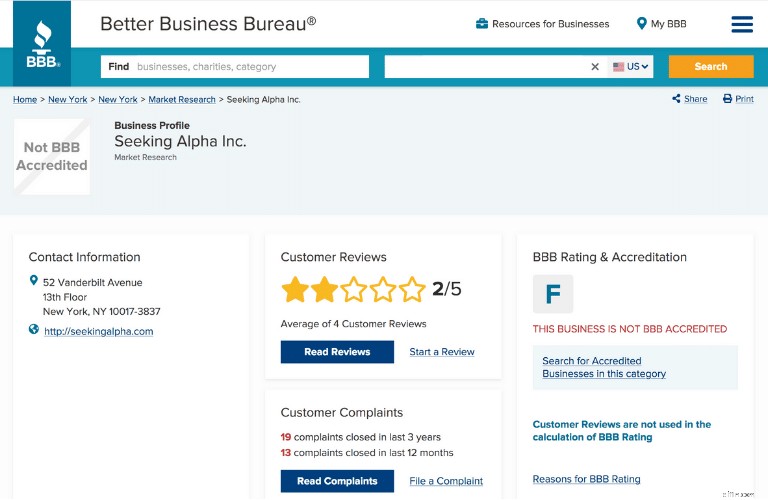
I even double-checked to see if I had the right Seeking Alpha company pulled up on my screen – and I did.
The common complaints appear to only apply to subscribers looking for the “free trial” period:
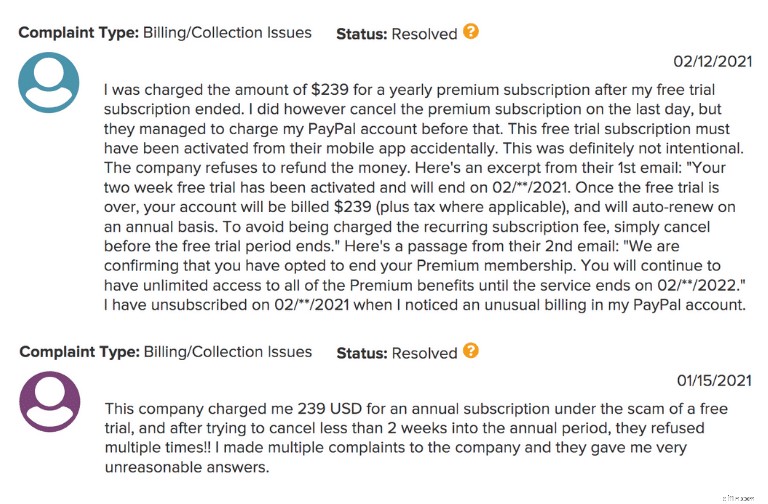
Based on these complaints (which are somewhat recent), it looks like many customers who signed up with the free trial period were charged after the period ended.
Based on this information, if I were signing up to the free trial period, I would probably triple check to read all of the fine print and possibly even cancel before the trial period is over (assuming you’re not happy with the platform).
Now that you have an idea of what people are unhappy about, let’s take a closer look at the ratings on TrustPilot, which is another customer review website.
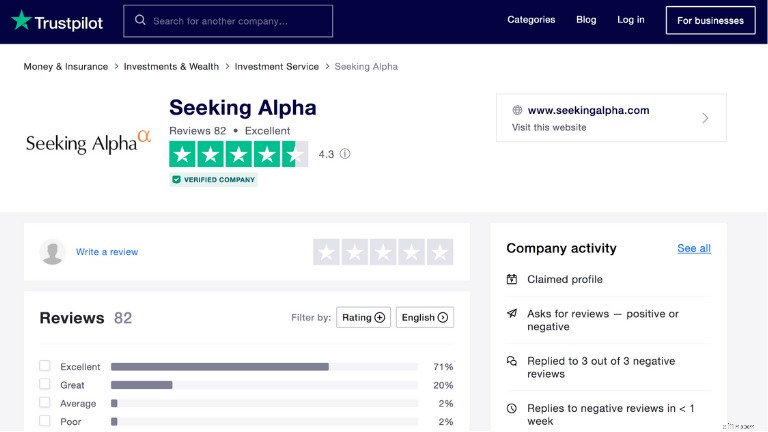
Now, this Trust Pilot customer review is more in line with what I was expecting to see.
On TrustPilot, a solid 93% of respondents rated Seeking Alpha average to excellent.
Some reviews are below:
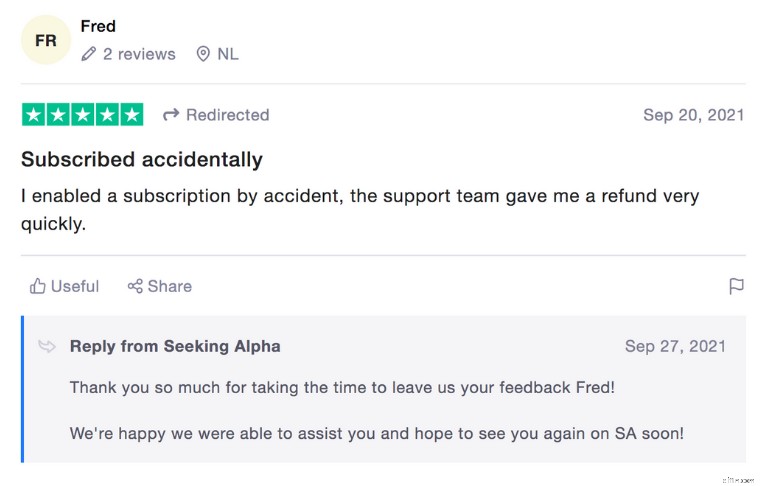
This review virtually contradicts the reviews from the BBB, which said Seeking Alpha did not offer a refund.
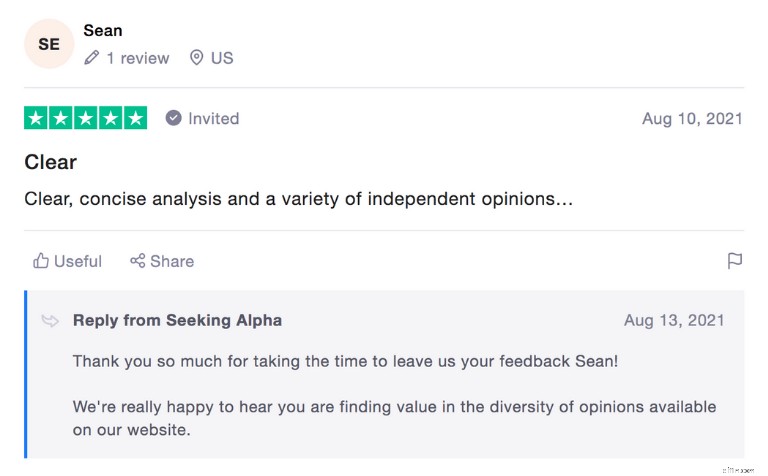
Above is another positive review about the accuracy and impartiality (no bias) of the authors that provide information on Seeking Alpha.
Of the 2 negative reviews that were posted from the 82 total reviews, the complaints were the following:
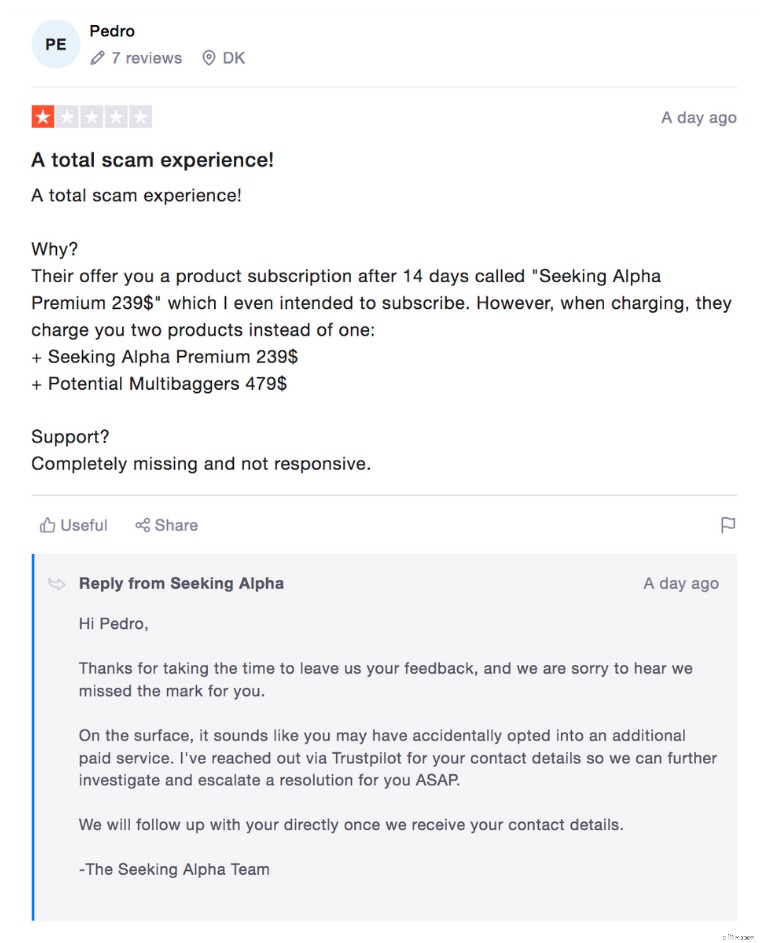
Take a look at the response time of when the negative review was posted (1 day ago) versus the reply from Seeking Alpha (also 1 day ago).
I thought that was impressive.
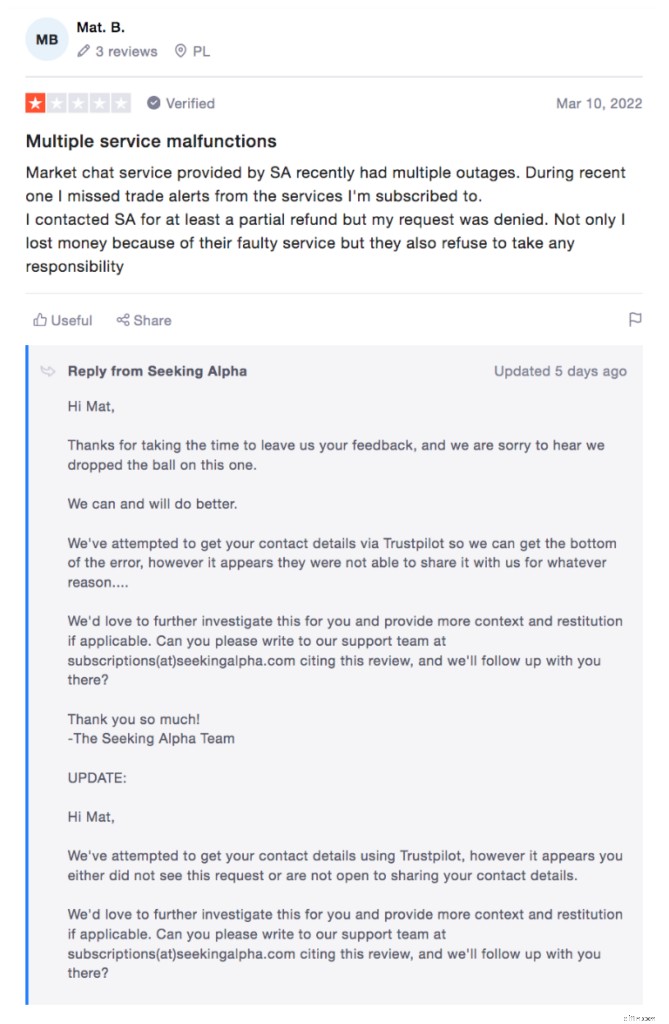
As you can see, there will always be good and bad reviews, and you’ll have to take the reviews with a grain of salt (seriously).
Personally, I like checking back into the customer service review platforms every few months, just to read updates.
Conclusão:
Most of the “Bad” Seeking Alpha reviews involve the free subscription service. According to the complaints, immediately after the free trial period ends, the consumer credit card will be charged the annual amount for a paid subscription (likely the Premium subscription).
The Author Vetting Process:Seeking Alpha’s Editors
Now it might sound daunting that Seeking Alpha offers works from 7,000 active monthly authors.
You might even be concerned about the quality of the information if there are so many contributors.
Their team has a pretty quick article turnaround time as well, which typically ranges between 1 hour to a few business days.
Do you have industry expertise and want to contribute?
Below are 9 of the most important requirements to pass the rigorous Seeking Alpha editorial review process:
Market-Oriented
Write about stocks, sectors, ETFs, or other actionable themes for US-based investors
Alta qualidade
Articles must be convincing, well-presented, and actionable
Fundamental Analysis
Articles must address factors such as a company’s competitors, products, management, corporate strategy, etc.
Originality
Always bring a new perspective to a topic
Compelling Title
Your title shouldn’t overpromise and underdeliver
Market Cap
Articles mentioning stocks trading at less than $1 or companies with market caps less than $100 million will receive extra scrutiny
Limpar
You must proofread your article before submission
No Promotional Content
No promotional content in articles
Human Factor
Editors work closely with contributors and maintain a constructive dialogue
As you can see, there are a lot of requirements that go into the making and the publication of a Seeking Alpha article, so chances are that you’ll get the high quality you want.
And with each month, over 10,000 articles are published on Seeking Alpha!
Another neat thing is that you can view a contributor’s past track record of stock predictions.
Another trick to finding information from top ranked authors is just simply clicking on the “Top Authors” button.
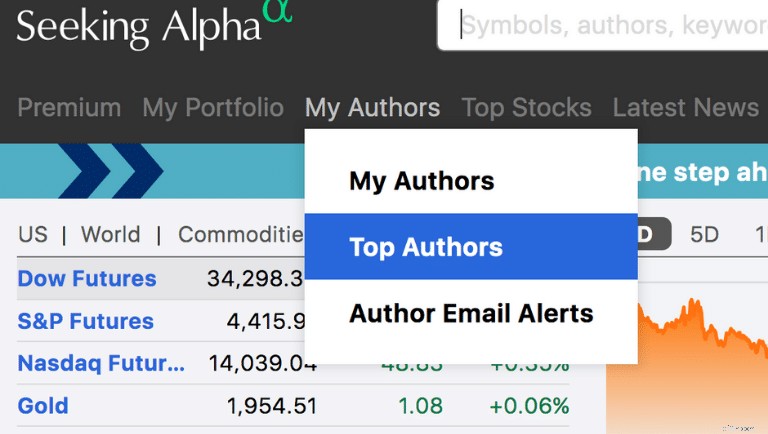
Once in the Top Authors section, you’ll receive a long list of author suggestions, based on their specialty (such as value investing, growth investing, oil &gas investing, etc.).
Seeking Alpha Educational Resources
Another reason why I’m a big fan of Seeking Alpha is because of the abundance of educational resources this platform offers its users:
Investment Videos
Access top investment news videos by clicking on the tab “Watch &Listen” and then clicking on “Videos”
Investment Podcasts
Learn more about the latest investment news by accessing 8 Seeking Alpha podcasts. Click on “Watch &Listen” and then on “Podcasts”
Financial Planning Education
Seeking Alpha knows that investing is just a part of the financial planning process. When you click on the “Education” tab, you’ll gain access to a variety of different financial planning topics, ranging from cryptocurrency to 401(k) management
Seeking Alpha Knowledge Base
Type any question into the search box and you’ll probably find an answer. The Knowledge Base can be accessed by clicking on the “Support” icon and then “Knowledge Base”
Feedback Forum
If you ever have trouble with the Seeking Alpha desktop website or the mobile app, this is the place to share your concerns, feedback, and interact with other users. Access the forum by clicking on the “Support” icon and then “Feedback Forum”
As you can see, Seeking Alpha does not keep you in the dark – when it comes to investing or financial planning-related matters.
One of my favorite learning sections on Seeking Alpha is the “Education” section, where Seeking Alpha users can learn about more than just investing.
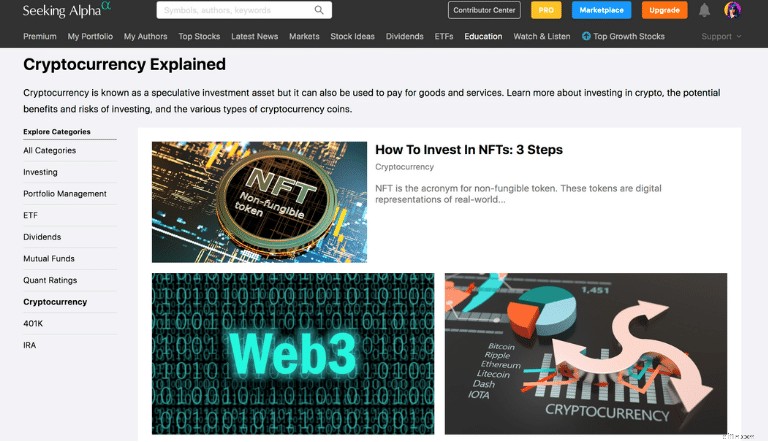
Under the education tab, you access articles about other topics that may not be covered in-depth by the Seeking Alpha Authors.
Some of these topics include:
- REITs
- 401(k)’s
- Cryptocurrency
- Capital gains taxes
I’m also a fan of the “Watch &Listen” section, which offers Seeking Alpha readers access to investment podcasts and videos.
If I’m ever stuck in traffic, I listen to one of the podcasts (I like the Wall Street Breakfast podcast).
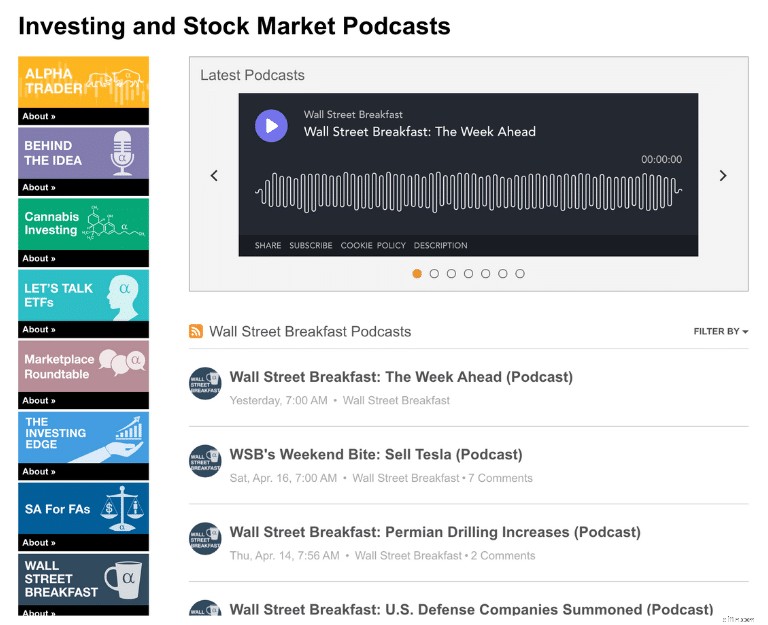
The good news is that Seeking Alpha offers so much variety from which to choose – you’ll never be left without ideas.
How to Open a Seeking Alpha Account
Ready to open an account with Seeking Alpha?
Believe it or not, it’s actually a very fast and simple process.
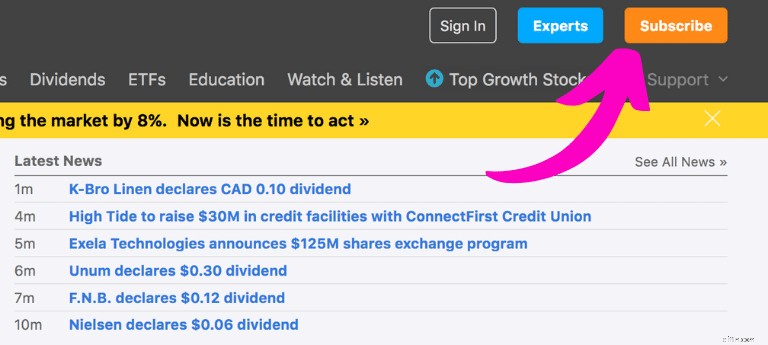
First, head to the Seeking Alpha website and click “Subscribe.”
After you click the subscribe button, you can choose to either start a free trial or register immediately with one of the 3 plans (Limited Access, Premium, or Pro).
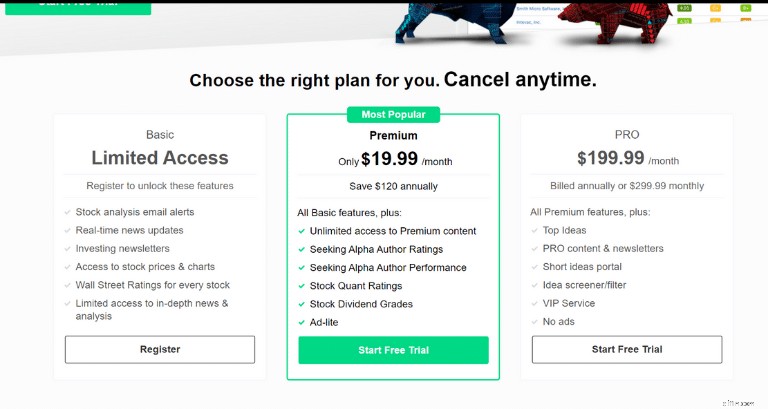
Now, if you’re ready to register and pay for your subscription, then select your plan preference.
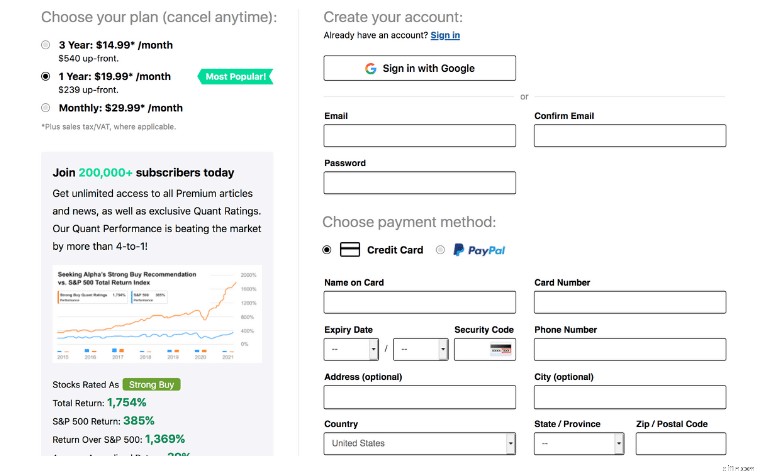
Payment methods are either via credit card or PayPal.
In my opinion, if you’re an investor who really wants to understand more about your investment holdings, then Seeking Alpha is probably a great platform for you.
Is Seeking Alpha Worth it?
Yes, Seeking Alpha is worth the cost if you do your own investment research and want to interact with experienced investors. For $19.99 per month, you get access to exclusive content from over 7,000 experienced investment authors, custom stock performance charts, and portfolio monitoring tools.
If you sign up to the Premium Platform, you can access the Seeking Alpha Quant Ratings, which have outperformed the market since 2010.
The Quant Ratings marked as “Very Bullish” for stocks were up 1,754% versus the market’s 385% gain.
On the other hand, the stocks that were rated as “Very Bearish” by Seeking Alpha really did underperform, being up by only 156% versus the market’s overall 385%.
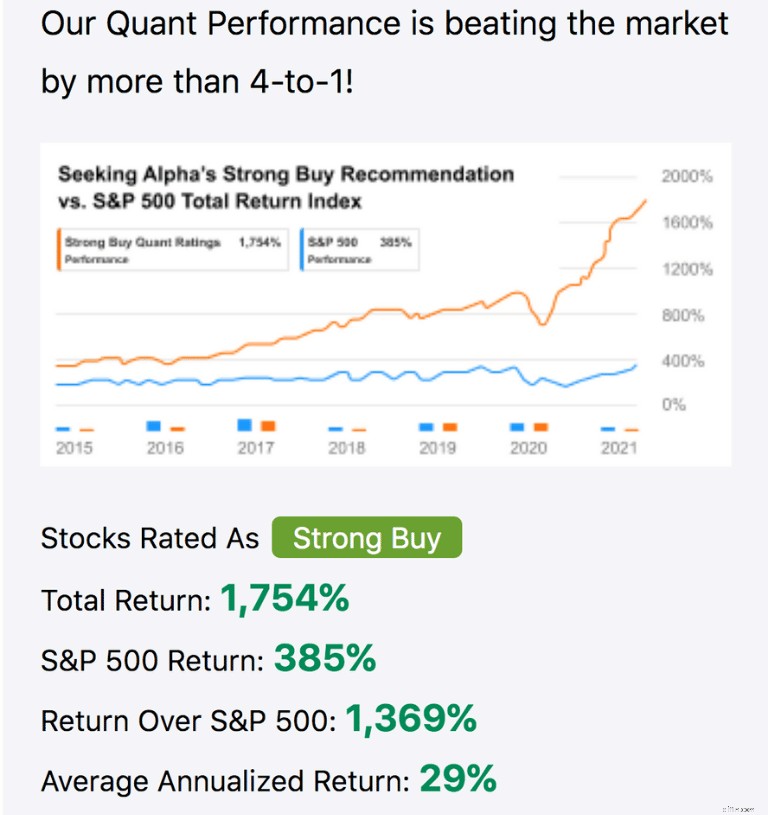
While I’m not a fan of day trading and stock picking, if I am looking to buy or sell a stock or fund in my portfolio, Seeing Alpha would be my first stop before hitting that “trade” button.
Seeking Alpha Alternatives
Seeking Alpha might not be for everyone.
If you’re an active investor and just don’t like the investment research platform, then you may want to check out platforms like the Motley Fool’s Stock Advisor.
While the cost is certainly lower for new members ($99 per year), you also don’t get access to the customization, the tools, and the crowdsourcing that Seeking Alpha uses.
You can always sign up to the free version of each platform first before committing financially.
Perguntas frequentes
Is Seeking Alpha Reliable?
Based on Seeking Alpha’s track record, yes, Seeking Alpha is reliable. As an example, Seeking Alpha’s “Very Bullish” stock evaluation ratings have outperformed the market since 2010, up 1,754% versus the market’s 385% gain.
Is Seeking Alpha membership worth it?
Seeking Alpha’s Premium membership is absolutely worth the cost if you want to conduct your own investment research and interact with experienced investors.
You pay $19.99 per month in exchange for exclusive access to content from over 7,000 experienced investment authors, custom stock performance charts, and portfolio monitoring tools.
Is Seeking Alpha Premium worth it?
Yes, Seeking Alpha’s Premium membership is worth the cost if you do your own investment research and want to interact with experienced investors. For $19.99 per month, you get access to exclusive from over 7,000 experienced investment authors, custom stock performance charts, and portfolio monitoring tools.
Is Seeking Alpha still free?
You can still use Seeking Alpha as a free user under the Limited Access plan. However, you can unlock only 5 articles per month before being prompted to sign-up as a paying Premium member. The Premium membership costs $19.99 per month as of early 2022.
Is Seeking Alpha good for day trading?
Seeking Alpha is probably one of the best tools for day traders, active investors, and even swing traders. If you want to do your own investment research and learn from industry experts, then Seeking Alpha really is a good fit.
Who should not buy Seeking Alpha subscription?
If you aren’t a day trader or someone who enjoys researching and picking stocks for their portfolio, then Seeking Alpha is probably not for you. For example, passive investors who use mutual funds, index funds, or even ETFs probably won’t find too much value from the Seeking Alpha platform.
Who Created Seeking Alpha?
Seeking Alpha was founded by David Jackson in 2004. Jackson is a graduate of Oxford University (undergraduate) and The London School of Economics (graduate).
He worked as a technology research analyst at Morgan Stanley, where Jackson saw a problem (the conflict of interest stemming from investment banks publishing information about the products they sell) and developed a solution with the unbiased Seeking Alpha platform.
Seeking Alpha Review:The Bottom Line
Seeking Alpha is likely one of the best platforms if you want to:
- Research your own stocks
- Get the latest stock market news
- Customize your stock performance
- Receive live stock push notifications
- Learn from and interact with industry experts
In my opinion, the biggest benefit you get from Seeking Alpha is the unbiased research.
For example, you won’t find research articles about funds written by the very company that sells the same fund.
There is no conflict of interest with Seeking Alpha, just pure authenticity and knowledge shared by industry experts.
You can access Seeking Alpha through 3 plans:
- Limited Access Plan
- Premium Plan
- Pro Plan
If you’re really planning to use Seeking Alpha as a way to evaluate your portfolio, research stocks, and learn (and interact) with investment industry experts, then you’ll probably want to sign up with the Premium Plan .
The Premium Plan offers the following features:
- Gain exclusive &unlimited access to expert articles
- Brainstorm your next stock picks with investment professionals
- Accurate and reliable stock recommendations (from both authors and Seeking Alpha’s quantitative analysis)
- Customize and compare your stock performance against a peer’s performance
- Track and learn more about your personal portfolio’s allocation and performance
The list really does keep going, but you get my point.
The Premium Seeking Alpha plan offers a lot of benefits, and that’s the plan that I’m using myself right now.
Conclusão:
What I really like about Seeking Alpha is that this investment research platform truly is a democratized platform that shares quality ideas and insights from industry experts.
Now I’d like to hear from you:
What are your thoughts on Seeking Alpha?
Would you consider opening an account with this platform?
Deixe-me saber na seção de comentários abaixo.
-

O malware WannaCry acabou, mas ainda deixa uma impressão duradoura
O ransomware se tornou um problema enorme Ao longo dos últimos anos, O ransomware se tornou um problema enorme nos Estados Unidos e no exterior. É também um problema único, muito diferente de outros
-

BigCommerce traz elegância para NRF 2022 e comércio após o anoitecer
Para dizer o BigCommerce a equipe ficou empolgada com a NRF 2022 seria colocá-lo levemente. Nossa primeira presença de estande em uma conferência desde março de 2020 também significou a primeira vez
Artigos em Destaque
- Quanto dinheiro você precisa na poupança de emergência? Aqui está o que Suze Orman pensa
- 3 maneiras de permanecer positivo
- 21+ INCRÍVEIS Estatísticas da Dívida Nacional para Conhecer em 2022
- Quando refinanciar seu carro:um guia de tomada de decisão
- Você tem um aviso de despejo. O que agora?
- Trabalhou remotamente em 2021? Aqui está o que você precisa saber sobre a dedução do Home Office
- Mais de 2 milhões de americanos se inscreveram no seguro de saúde graças à provisão de Biden
- O que são carteiras móveis? E eles fazem sentido para você?
-
 As vantagens e desvantagens da negociação de CFD
 Para investidores experientes, A negociação de CFDs oferece muitas oportunidades para diversificar seu portfólio e lucrar com o movimento dos preços nos mercados financeiros. Mas também traz seus próp...
-
 O seu patrimônio líquido afeta sua pontuação de crédito?
 Muitos ou todos os produtos aqui são de nossos parceiros que nos pagam uma comissão. É assim que ganhamos dinheiro. Mas nossa integridade editorial garante que as opiniões de nossos especialistas não ...